Showing posts with label The Nature Conservancy. Show all posts

Friday, April 13, 2018

New paper: how "boundary spanners" help innovation spread

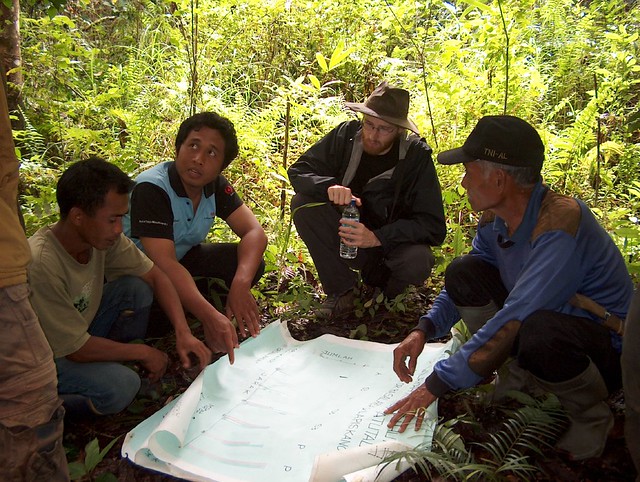
village conservation meeting

There's another paper out from the study of how Conservation by Design (CbD) 2.0 spread through TNC and beyond.

This paper (led by Yuta Masuda, I'm a co-author) focuses on "boundary spanners" - people with informal connections across departments / geography. These “boundary spanners” are four times more likely to spread information about “innovations” (here that means info about CbD 2.0) and to drive changes in attitude that encourage adoption. However, their advantage in spreading info only exists when they have <4 direct reports and are relatively low in the organizational hierarchy (counting levels of who reports to their direct reports etc. etc.).

There's a blog with more info at: https://www.sciencedaily.com/releases/2018/04/180409090127.htm and you can read the paper at http://rdcu.be/Kre4 

Masuda, Y. J., Liu, Y., Reddy, S. M. W., Frank, K. A., Burford, K., Fisher, J. R. B., & Montambault, J. (2018). Innovation diffusion within large environmental NGOs through informal network agents. Nature Sustainability. https://doi.org/10.1038/s41893-018-0045-9

Thursday, March 1, 2018

March 2018 Science Journal Article Summary


Hi,

It has been a hectic month so I haven't read much science. I'm including two articles on beef sustainability (one exciting case study, and one much broader review), as well as a new paper of mine that was finally published after an epic 14 month review. My paper looks at how information about CbD 2.0 spread within TNC and beyond, and while it's long and dense I'd encourage you to at least check out the summary below for tips on how to aid "knowledge diffusion" and how to study it.

BEEF SUSTAINABILITY:
Stanley et al. 2018 is a paper arguing that proper grazing management may be able to make beef a net carbon sink. They don't go quite that far, but it's a reasonable extrapolation. While this is an encouraging case study and we should look carefully at how to apply it, there are some really important caveats to interpreting this more broadly. Specifically, they found using "adaptive multi-paddock (AMP)" grazing for the finishing phase of cattle instead of feeding them grain resulted in a sink of ~6.7 kg CO2e / kg carcass weight, compared to a source of ~6.1 kg CO2e / kg for feedlot beef. The study is designed well, and soil C improvements were measured empirically over 4 years, in three types of soil in the Upper Midwest. That being said, there are a few big issues that challenge the narrative of "carbon positive beef" being possible at wide scales:
  1. The soil sequestration here (3.6 Mg C / ha / yr) is much higher than is typically reported (although some studies have shown similar rates).
  2. These rates would diminish over time; it's not clear how fast the soil would saturate but high rates like this would be most likely in early years after improving management of highly degraded soils.
  3. This study was on alfalfa pasture (which fixes N); it's unlikely these results would apply to unfertilized rangelands
  4. The study did not include soil nitrous oxide emissions which are often substantial in leguminous pastures.
  5. Finally, the grass-finished beef took up twice as much space as the feedlot beef. That could be good from a perspective of prevent conversion of grasslands by keeping them in production, but it also means that if we scaled up grass-finished beef at this density, we'd have to find twice as much land to graze cattle on, which could drive conversion. It would also likely raise costs for producers and consumers.

Garnett et al. 2017 ("Grazed and Confused") is a very thoughtful review of the climate change / GHG impact of ruminants (largely cattle). Their first key findings is that even with good grazing ruminants still have high net GHG emissions. They also note sequestering soil carbon often has trade-offs with methane and nitrous oxide. Finally, as demand for animal protein rises sharply there is likely to be both land conversion and increasing GHGs as a result. These have all been reported widely in other studies, but it's a nice summary. On the one hand, it's hard to pull out quantitative results from this paper. On the other, it does a great job of covering the various arguments and counterpoints around cattle and carbon, and presenting the data in a value-neutral tone. Anyone interested in this topic should at least skim the 8-page summary.

KNOWLEDGE DIFFUSION:
Fisher et al. 2018 ("Knowledge diffusion within a large conservation organization and beyond") looks at how people find information about innovations and share them, specifically the spread of Conservation by Design 2.0 (CbD 2.0). We review how earlier versions of CbD spread from TNC (looking at published science articles and expert interviews), then use tons of varied data to look at CbD 2.0. I wrote a blog about the paper here: http://sciencejon.blogspot.com/2018/03/share-good-news-paper-on-improving.html
and the full paper is at: http://journals.plos.org/plosone/article?id=10.1371/journal.pone.0193716
but here's a summary of what we learned:
  1. Sending repeated broadly-targeted communications (e.g. all-staff email / newsletters / etc.) that make it easy for recipients to find out more worked better than more narrowly focused communications (e.g. plenary talks, emails from executives).
  2. Expert interviews revealed several factors to promote diffusion: bringing in partners early to develop and test methods, committing up front to sustain support for the planning methods, having in-person workshops, using peer-review and shared learning, providing financial support, explaining how the methods address existing needs planners already have, and the existence of a support and learning network like the conservation coaches network (CCNET). 
  3. Organizations may wish to use internal data to identify staff likely to play a key role in diffusing so that they can encourage that process (the paper has details on how, with more forthcoming in an upcoming paper)
  4. Working with academics on publications represents a potential way to get the word out with relatively low effort for organizations (academics I have worked with in other contexts are often very interested in data no one else has access to, and have published cool papers from those data). 
  5. For scientists interested in this topic, we learned a lot about how to study knowledge diffusion, and share tips for researchers (e.g. thinking about image-blocking, legal and privacy constraints, distinguishing internal and external website visits, etc.).

REFERENCES:
Fisher, J. R. B., Montambault, J., Burford, K. P., Gopalakrishna, T., Masuda, Y. J., Reddy, S. M. W., … Salcedo, A. I. (2018). Knowledge diffusion within a large conservation organization and beyond. PLoS ONE, 13(3), 1–24. https://doi.org/10.1371/journal.pone.0193716

Garnett T., Godde C., Muller A., Röös E., Smith P., de Boer I.J.M., Ermgassen E., Herrero M., van Middelaar C., Schader C. and van Zanten H. (2017). Grazed and confused? Ruminating on cattle, grazing systems, methane, nitrous oxide, the soil carbon sequestration question. Food Climate Research Network, University of Oxford http://www.fcrn.org.uk

Stanley, P. L., Rowntree, J. E., Beede, D. K., DeLonge, M. S., & Hamm, M. W. (2018). Impacts of soil carbon sequestration on life cycle greenhouse gas emissions in Midwestern USA beef finishing systems. Agricultural Systems, 162(November 2017), 249–258. https://doi.org/10.1016/j.agsy.2018.02.003
Share the good news: a paper on improving "knowledge diffusion"


Ever feel like you missed out on a super cool Kickstarter project and you can’t believe no one told you about it? Amidst the fire hose of blogs, podcasts, social media, and more, how can we help good ideas get noticed, get shared, “go viral,” and make change happen?

That’s the question that a few scientists at The Nature Conservancy (TNC) decided to tackle back in 2014 (http://blog.nature.org/science/2015/07/29/tracking-how-new-science-spreads/). Scientists usually don’t get to tell others what to do, and we don’t have many celebrity advocates or adorable cat videos to explain our research. So to influence others we often have to be creative, “lead by intrigue,” and hope our message catches on. But for a new idea to go viral, it helps to understand how it spreads from person to person.

Our first journal article on this research (published in PLoS ONE, http://journals.plos.org/plosone/article?id=10.1371/journal.pone.0193716) taps into a huge array of different data sources including tracking web page activity, TNC employee data, and more traditional detailed surveys to give us some initial clues about how people are learning about innovations and sharing them with others. Going this deep with different kinds of data to explore diffusion is novel, and we learned some cool tricks other scientists may want to use!

Scientists call the way that new ideas spread “diffusion of innovations.” The process includes learning about and considering a new idea, trying it out, and telling others about it (not necessarily in that order).

Some innovations are new technology or practices (e.g., seven science innovations changing conservation, http://blog.nature.org/science/2017/04/17/7-science-innovations-changing-conservation/). We focused on a more conceptual example: the spread of the new scientific principles and planning methodology at TNC: Conservation by Design AKA CbD, https://www.nature.org/science-in-action/conservation-by-design/index.htm. We asked how TNC staff and others received this new information, sought to learn more, and shared it.

CbD dates back 20 years and we saw lots of interest in it from beyond TNC in published science articles. Experts we interviewed said that ideas spread when you bring in partners early, invest in training and support, and do several other things which TNC did from the beginning).

We didn't find a silver bullet for communications that got people to seek out more information. But simple broad communications like short articles in internal newsletters and webinars to all staff worked best to promote seeking more information about CbD (as shown in the figure below, which tracks how many people went to a web site to learn about CbD in response to different events). The more venues through which someone heard about the new ideas in CbD 2.0, the more likely they were to share, so repetition was key.


There were several other factors that made people more likely to share information. Some were obvious, like people whose job included training others in conservation planning methods. Others were less obvious, e.g. people who took more online trainings (not limited to conservation) were more likely to share information about CbD 2.0.

We also learned that even with all the data available to us, there were still some surprising limitations. For example, Google Trends, much touted as a “Big Data” approach to track public interest in different topics, turned out to have unreliable data. Plus, it’s not specific enough: TNC’s “conservation by design” gets searched for less than a private company with the same name. So searches for “our” CbD got lost.

Most of my research tries to find how much information we need to make the right decisions without wasting time on unnecessary analysis. With the findings of this new paper, we have new insights into how we can share those tips and avoid either wasting time or making the wrong call.


So the next time you miss out on that sweet Kickstarter project, let me know, and let’s see if we can figure out how to better prepare for the next one.

Fisher, J. R. B., Montambault, J., Burford, K. P., Gopalakrishna, T., Masuda, Y. J., Reddy, S. M. W., … Salcedo, A. I. (2018). Knowledge diffusion within a large conservation organization and beyond. PLoS ONE, 13(3), 1–24. https://doi.org/10.1371/journal.pone.0193716

Friday, April 14, 2017

Call to Action: Use Habitat to Reduce E. Coli on Leafy Greens

I gave a short talk at the DC March for Science about Daniel Karp's research on wildlife habitat and food safety (you can watch a recording of my talk here and also download the slides if you like), and I would like to encourage people to take action on it.

Essentially he found no evidence that clearing habitat near leafy greens reduces E. coli contamination. In fact, his research provides some preliminary evidence that habitat removal could actually increase food safety risk. However, it is not clear that companies buying greens have gotten the message, and some of them are likely still requiring or encouraging farmers to destroy habitat.

When you buy greens, please reach out to the company producing / packaging the greens, and ask them to discourage farmers from clearing habitat (sample text you can use in an email is below). You can also talk to the staff at the customer service desk of the grocery to ask them about their sourcing criteria, and pass on the information about this research.

Sample text:
"I've recently become aware that many buyers of leafy greens have been requiring or encouraging farmers to clear natural habitat near to their fields, out of concern for possible contamination by wildlife. However, now that scientific research has found no evidence that clearing habitat near leafy greens reduces E. coli contamination (and provides some preliminary evidence that habitat removal could actually increase food safety risk), I'm hoping that you will disincentive your growers from clearing habitat. Please let me know how you are engaging on this issue. You can read a blog summarizing the findings here: http://blog.nature.org/science/2016/06/03/nature-doesnt-hurt-farmers-it-helps/
and the full references are:
Karp DS, Gennet S, Kilonzo C, Partyka M, Chaumont N, Atwill ER, et al. Comanaging fresh produce for nature conservation and food safety. Proc Natl Acad Sci. 2015; doi:10.1073/pnas.1508435112

Karp DS, Moses R, Gennet S, Jones MS, Joseph S, M’Gonigle LK, et al. Agricultural practices for food safety threaten pest control services for fresh produce. Manning P, editor. J Appl Ecol. 2016;53: 1402–1412. doi:10.1111/1365-2664.12707"

Thanks for helping to protect wildlife habitat!

Tuesday, May 24, 2016

New massive database of peer-reviewed science publications from The Nature Conservancy

I forgot to link to a post I put up in February about a new resource I worked on pulling together. We now have over 2,000 peer-reviewed articles and book chapters written by staff at The Nature Conservancy in a fully searchable database!

You can read more about it on Cool Green Science:
The Nature Conservancy’s Massive New Science Article Database (blog post)

or jump right in and start searching here:
 http://bit.ly/TNC_articles


Reading Room, Jefferson Building, Library of Congress. Photo © Matthew and Heather/Flickr through a Creative Commons licens

Growing local tomatoes

This is part two of the videoI worked with some colleagues from the Nature Works Everywhere program about the sustainability of growing tomatoes. You can read more about it and grab a lesson plan if you like.


The Local Tomato from The Nature Conservancy on Vimeo.

Friday, September 19, 2014

Reforestation to reduce ozone without costing businesses extra money

Air quality in Beijing
A new paper (on which I'm an author) was just published in PNAS on our collaboration with Dow. In particular, we looked at reforestation as a tool for ozone abatement, with the key finding that in Houston reforestation was cost-competitive with building scrubbers (which has a high initial capital cost and cannot readily be adjusted to a precise need for removal) and NOx allowances. If carbon credits could be sold it would be cheaper.

There are plenty of caveats (the legal framework to actually do this is not in place yet, we assume land owners exist who want their lands reforested (as opposed to having to buy land), it only works in places with NOx-limited ozone and ozone non-attainment areas, etc. Also, the national map I made (above) is a coarse analysis showing where this could be replicated, but does not include factors like the current drought in California (the intent is to flag areas deserving a closer look if the policy piece goes through). For the paper, I did a more rigorous habitat assessment about where within the study area a specific type of bottomland hardwood forest could likely be planted successfully.

Nonetheless, it is exciting that in this case we found that a natural solution could be appealing to businesses, while also providing benefits to others (habitat, recreation, etc.). I was only peripherally involved (in the mapping out of where this could work), but I'm still pretty proud.

There is a blog post about why this paper is arguably significant here:

The TNC blogs with more info have expired, but the actual paper is here:
More information: Reforestation as a novel abatement and compliance measure for ground-level ozone, Timm Kroeger, PNAS, DOI: 10.1073/pnas.1409785111

Read more at: http://phys.org/news/2014-09-reforestation-urban-areas-ozone.html#jCp


Wednesday, October 10, 2012

Where does your water come from?

Do you know where your water comes from? Many people don't, and it's important if you want to know how secure your water supply is. This new map shows you where the water comes from for almost 500 cities around the world, and for 27 of those cities we have maps showing how much of the place your water comes from is unprotected. The goal is to inspire people to realize that protecting nature near them helps to ensure their continued access to clean water. You can see the map here: http://www.nature.org/all-hands-on-earth/water


The report explaining how the data behind the map was generated is here: http://www.nature.org/idc/groups/webcontent/@web/@northamerica/documents/document/prd_056889.pdf

While I didn't have anything to do with generating the data, I'm pretty proud of how the map was put together, so for those interested, here's how it works. We wanted an easy to use interface (Google Maps being the best choice for simplicity), a really easy way for non-techies to update the data (Google Fusion Tables is great for this), but we also wanted to have full control over the look and feel of the base map (which is much harder to do with Google).

I found some existing code that lets you combine Esri map services (which we can easily customize the look of) with the Google Maps javascript API: http://google-maps-utility-library-v3.googlecode.com/svn-history/r172/trunk/arcgislink/docs/reference.html. That way we get the best features of each of the three publishing options without some of the baggage (fusion tables by default has an awkward interface, Esri products are harder to update and the interface isn't quite as nice, Google Maps has limited base map options).

Since we had two kinds of popups for different cities, we used two different Fusion Tables:
The update process is pretty simple: to add more cities to the map, you just go to Fusion tables and import a spreadsheet with the new cities to add more rows. Google uses the concatenated "City, State" column to map each city (for international cities we use the format "City, Country").

You can simply view the source code of http://www.nature.org/all-hands-on-earth/water to see how it was accomplished, but I also have some simpler examples to help you get started if you want to replicate this approach:

Wednesday, October 3, 2012

The influence of priority areas on conservation land acquisitions

I just had this paper published in PLoS ONE, which examines the influence that defining priority areas had on where The Nature Conservancy acquired land. In other words, did setting priorities actually cause us to behave differently, or not? Rather than spoil it for you, you can read the answer for yourself here:
http://dx.plos.org/10.1371/journal.pone.0046429