Showing posts with label book chapters. Show all posts

Friday, May 24, 2019

New book chapter (from CUP) available on agricultural metrics & corporate sustainability

Once upon a time (late 2013 or early 2014) I was asked to co-write a chapter on sustainable agriculture metrics with Peter Kareiva. I learned a lot writing it, and when I realized it would take a while to get published I wrote a blog post about the most surprising thing I learned (that global agricultural land had been decreasing since 1998, not rapidly expanding): https://blog.nature.org/science/2014/06/18/global-agriculture-land-sustainability-deforestation-foodsecurity

That surprise, and the blowback I got after publishing it, inspired me to write another book chapter which came out in late 2017:
http://fish.freeshell.org/publications/DataNotDogma-Chapter11-preformatted.pdf
and a follow-up blog since my writing wasn't clear enough: http://sciencejon.blogspot.com/2018/01/take-2-what-i-wish-id-put-in-my-recent.html

But now, 5+ years later, the actual original book is finally published!

Those interested can read the final chapter at http://fish.freeshell.org/publications/FisherKareiva_CUP_2019_preformatted.pdf

The first half is OK but is out of date and was written when I knew far less about agriculture. I'd skip to the 2nd half (start with the "Can Corporate Sustainability reporting be a force for improved agricultural practices?" section). There's some interesting content I haven't seen anywhere else on corporate sustainabiltiy and food labels.

I haven't read the rest of the book yet but am looking forward to it! You can get the whole book here:  Agricultural Resilience: Perspectives from Ecology and Economics (Cambridge University Press)

Wednesday, January 3, 2018

Take 2: what I wish I'd put in my recent book chapter

I asked my wife Sarah to take a look at my recent chapter in the book "Effective Conservation Science: Data Not Dogma" and she made an excellent point: what should the take-away be? Here are the things I was hoping to convey but wasn't sufficiently clear about.

The key fact I wanted to convey is that the global agriculture situation is complex: the global land used for agriculture hit its peak in 1998 (so it's not true agricultural land is rapidly expanding around the world), BUT in some places there is a lot of agricultural expansion and/or reliance on unsustainable levels of water and nutrients. So there is good news and bad news.

Some other important facts I didn't go into in much detail:
  • In the last two decades we have been able to meet increasing demand for food through intensification (producing more food on existing lands). But going forward projected demand rises faster than what we're likely to be able to produce through intensification. So between 2030-2050 we can expect conversion to agriculture to speed up and lead to a net expansion of land used for agriculture.
  • Agriculture in many regions currently relies on unsustainable irrigation. As groundwater is depleted and crops get thirsty we can expect yields to eventually fall substantially on agricultural lands in water-scarce areas. The California drought gives us a taste of what that could look like. Note that changes in irrigation technology are likely insufficient to solve this on their own (see the summary of Richter 2017).
  • Other agricultural inputs may start to run out or at least limit improved crop yields. That could include rock phosphate for fertilizer or even nitrogen fertilizer if actions to limit climate change make it more expensive.
The key message of the piece for other scientists is: don't assume that things that seem obvious (like ag land rapidly expanding) are true, and don't assume that global data sets are reliable enough to inform policy or other action. Dig deeper! Ask questions, and look for more local data to corroborate your suspicions.

Let me know if you have other questions or suggestions!

Wednesday, October 18, 2017

New book: "Effective Conservation Science: Data not Dogma"

I have a chapter in a new book that was just published:
Effective Conservation Science: Data not Dogma (click the link to read more and buy it if you like).

The book has a really cool theme: what happens when we find evidence that contradicts what "everyone knows"? How do people react, and how do we resolve the disconnect?

In my case, while doing research for another book, I discovered that global land used for agriculture had actually been declining since 1998, despite the narrative that ag was rapidly expanding around the world.

I got a lot of pushback when I blogged about it a few years ago, and this chapter tells the story of what I found, what the reaction was, and what it all means going forward.

I really think the book is a great read based on the several chapters I've read so far, so if you're interested I encourage you to buy it. If you're not sure, you can read a review of a different chapter, or read the ugly (unformatted) version of my chapter here: Global agricultural expansion: the sky isn't falling (yet), and read another blog I wrote on the chapter with better framing and explanation here: Take 2: what I wish I'd put in my recent book chapter

Here's a map showing where around the world agriculture IS expanding, and where it's contracting:

Sunday, September 25, 2016

Sneak preview of (hopefully) upcoming publications

From August 2016 through the end of this year, I hope to have submitted 10 peer-reviewed articles / chapters for publication! In the meantime I'm hard at work writing as much as I can.
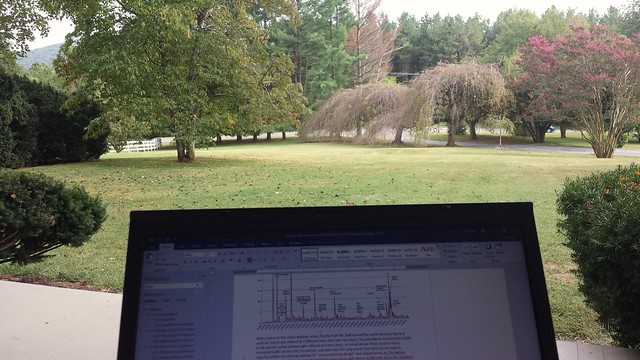
Science writing outside at briar patch b&b

They are as follows (let me know if you want any abstracts):
1. A remote sensing paper where we detected agricultural ditches and ridge-tillage, and show how important those practices are for erosion control in our study area in Kenya (submitted, second author).
UPDATE: published at http://www.tandfonline.com/doi/full/10.1080/01431161.2017.1327125
2. A book chapter for a Oxford University Press book about scientific findings that go against expectations. It's about the analysis I did for another book chapter (Cambridge University Press, not published yet) which I reported on here: http://blog.nature.org/science/2014/06/18/global-agriculture-land-sustainability-deforestation-foodsecurity/ (Reviewed / Accepted, sole author).
UPDATE: publishedhttps://global.oup.com/academic/product/effective-conservation-science-9780198808985?cc=se&lang=en& and an ugly unformatted version is available at http://fish.freeshell.org/publications/DataNotDogma-Chapter11-preformatted.pdf

3. A paper outlining how we tied traditional detailed household surveys to spatial data by having farmers outline their actual plots on tablets with high resolution imagery (should be submitted in a few weeks, second author)
UPDATE: Has been submitted and rejected twice, both times after a 4-month review with only one reviewer. Submitted a third time.

4. A paper that was part of a water fund project in Brazil; a water treatment company is going to pay for conservation to reduce the costs of treating the water. So the paper asks how much of a difference it makes if we use high resolution data (expensive and time consuming) vs low resolution (free and faster) on our water quality estimates (hopefully submitted in a month or two, first author). UPDATEpublished at http://onlinelibrary.wiley.com/doi/10.1002/rse2.61/full

5.-8. There is a series of four papers on knowledge diffusion (spread and uptake of new ideas); I'm leading one and I believe I'll be on the other three as an author since we've been working together on the research as a team for 2 years. The one I'm leading uses a rich array of data to examine both internal and external diffusion at The Nature Conservancy (TNC) from a few different angles, one uses an experiment to show how "boundary spanners" (people with social networks that connect to a variety of other groups) play a critical role in spreading knowledge, one looks at how people actually change what they do in response to new methods becoming available, and one compares two groups within TNC and examines how their response to and alignment with the new methods differs. Read more about the overall project here: http://blog.nature.org/science/2015/07/29/tracking-how-new-science-spreads/ (will all be submitted by end of October, one as first author and the rest as a minor author)
UPDATE: 1 published (http://journals.plos.org/plosone/article?id=10.1371/journal.pone.0193716), 1 accepted, 1 submitted, 1 more being revised for resubmission

9. We are working on a remote sensing analysis in high altitude grasslands of Peru, seeking to remotely estimate the amount of forage (grass etc) available for grazers, as part of a model that will support another water fund. I did much of the research design, but colleagues collected the field data and my intern Trisha is now beginning the remote sensing analysis. (should be submitted by end of December, maybe 3rd/4th author).
UPDATE: We scrapped this one given too many competing papers and projects.

10. A peer-reviewed version of a report we wrote on the U.S. beef supply chain (impacts across different phases of production like grazing and feed production and feedlots) should also be submitted. The report was just released to stay tuned for a post about that.
UPDATE: Rejected twice, and we don't plan to submit again.

Also I have a completed / reviewed / accepted CUP book chapter that has been in limbo for a few years (the one mentioned in #2 above) and should come out next year, and there are 1-2 more articles that may happen probably submitted early next year (led by others but on which I'd be a co-author). Stay tuned! Unless they're all rejected outright 2017 should be a good year for my publications...
UPDATE: the book chapter is now supposed to be out late in 2018. One other paper was submitted on the Camboriu Water Fund and is under review.

Tuesday, May 24, 2016

New massive database of peer-reviewed science publications from The Nature Conservancy

I forgot to link to a post I put up in February about a new resource I worked on pulling together. We now have over 2,000 peer-reviewed articles and book chapters written by staff at The Nature Conservancy in a fully searchable database!

You can read more about it on Cool Green Science:
The Nature Conservancy’s Massive New Science Article Database (blog post)

or jump right in and start searching here:
 http://bit.ly/TNC_articles


Reading Room, Jefferson Building, Library of Congress. Photo © Matthew and Heather/Flickr through a Creative Commons licens