I've already mentioned two earlier papers I've published on the adoption of a new conservation planning framework (Conservation by Design 2.0, or CbD 2.0 for short) being rolled out by The Nature Conservancy. Those covered knowledge diffusion and how 'boundary spanners' can increase it. The latest (probably the last) paper from that research is now available here:
https://journals.sagepub.com/doi/full/10.1177/1086026619880343
Here's the submitted version of the article (not the nicely formatted one, which you need a subscription for): http://fish.freeshell.org/publications/Reddy2019-BehaviorChange.pdf
This paper is not very accessible to a broad audience, so here's a short summary:
Reddy et al. 2019 looked at the adoption of a new conservation planning framework (Conservation by Design 2.0) being rolled out by The Nature Conservancy. Some staff & teams were early adopters, but it was slow to spread. But people who worked on projects with early adopters from different teams were more likely to use the new practices. Having early adopters work with people from different teams who are slower to change can speed exposure to new ideas and help everyone to learn and adapt. Supervisors should encourage talent-sharing and learning exchanges so this happens more.
That's about it!
Showing posts with label knowledge diffusion. Show all posts
Showing posts with label knowledge diffusion. Show all posts
Saturday, October 12, 2019

Tuesday, May 1, 2018
May 2018 Science Journal Article roundup
Merry May!
Most of this summary was written on a red-eye flight to China, so apologies if it makes even less sense than usual, and please let me know if you spot errors or omissions! There's some focus on habitat conversion, but I threw in two water quality papers, plus one each on grazing and soil C, and one on knowledge diffusion.
KNOWLEDGE DIFFUSION / INFORMATION SHARING:
There's another paper out from the study of how Conservation by Design (CbD) 2.0 spread through TNC and beyond. This paper (led by Yuta Masuda, I'm a co-author) focuses on "boundary spanners" - people with informal connections across departments / geography. These “boundary spanners” are four times more likely to spread information about “innovations” (here that means info about CbD 2.0) and to drive changes in attitude that encourage adoption. However, their advantage in spreading info only exists when they have <4 direct reports and are relatively low in the organizational hierarchy (counting levels of who reports to their direct reports etc. etc.). There's a blog with more info at: https://www.sciencedaily.com/releases/2018/04/180409090127.htm and you can read the paper at http://rdcu.be/Kre4
HABITAT CONVERSION:
Nevle & Bird 2008 is grim but fascinating. They find a connection between seemingly unrelated factors: global CO2 levels and pandemics among indigenous people in the Americas brought on by European contact. They link the population crash to a reduction in burning of forests for swidden agriculture, subsequent forest regrowth storing ~5-10 Gt carbon, and argue this is a likely contributor to a small measured reduction in global atmospheric CO2 at the same time. It's more of an interesting hypothesis with data which is consistent than real 'proof' but it's still a fascinating (if depressing) read.
OK, you know food choices matter for habitat conversion, and several alternatives to conventional meat are 'hot' right now. But what protein source has the most promise for sustainability? Alexander 2017 has some answers. They look at a few categories: insects (crickets and mealworms), plant-based imitation meats (they looked at humble tofu rather than newer products like the 'bloody' impossible burger), cultured meat (real meat from animal cells grown in a lab), and aquaculture. Fig 1 has the results on efficiency - tofu came out on top (if you find it gross, let me know, preparation is key and rarely done right in the US), followed by bugs. Cultured meat didn't have much edge over pork and poultry. Table 2 then shows what the global impact on land use would be under different diet change scenarios (including odd ones like replacing 50% of current animal products with beef, doubling the ag footprint on earth). While insects came out as less efficient than plant foods, that could change if we found ways to use food waste for a significant portion of the insect feed.
Chaplin-Kramer 2015 asks how much it matters which lands get deforested in terms of impact on carbon storage and biodiversity. They look at two regions of Brazil and find where conversion happens affects its impact by a factor of 2-4, which conversion deep inside forests more harmful than nibbling away at the edges (although they note that their modelling scenarios use patterns different from what is typically seen in the real world). The discussion has some good points about how development of roads into new regions will likely have a higher impact than investment in infrastructure around existing agricultural lands.
Tyukavina et al 2017 has details on deforestation and forest degradation in the Brazilian Amazon since 2000. Figure 2A is my favorite - it conveys both the reduction in overall tree cover loss since a 2004 peak, and also the shift in what the land was cleared for. Pasture is consistently the biggest chunk, followed by swidden (small scale slash & burn) and then permanent croplands. There's lots of other interesting data here but that figure was the high point for me.
Wright et al 2017 uses a recent high-quality data set on conversion of natural habitat to / from farmland to show that there is a correlation between how much habitat was converted to farmland and how close the land is to the nearest ethanol refinery. While this study didn't correct for other factors, they point to another study which did and still found refinery proximity to be significant with conversion. The ability of refineries to stimulate conversion were highest where corn acreage was low to start. See http://wxpr.org/post/study-links-ethanol-production-habitat-destruction for a blog post aobut this one.
Kastens et al 2017 uses remote sensing data to look at conversion of forests in Brazil to soy farmland. The key finding is that the forest to soy conversion rate was cut in half after the 2006 soy moratorium. You can see the shift in Figure 5 by noting the change in the slope of the green line, but the abrupt difference right after the moratorium is more apparent in table 3.
AGRICULTURE (WATER QUALITY):
Hansen et al 2018 is a cool paper using empirical data to test how effective wetlands in the Minnesota River basin are at reducing nitrates in an ag landscape compared to cover crops and land retirement. They compared river water quality at ~200 sites under different flow conditions to high-resolution data on wetlands and land use to map correlations (they didn't get at true causation). They found wetlands were 5 times more effective per unit area at removing nitrates compared to cover crops and land retirement (although it's much harder to make a business case to a farmer around wetland creation). They also found wetlands strategically placed to intercept as much flow as possible were much more effective (see Fig 4 - the concept is obvious but the numbers are interesting). All these findings align well with prior work emphasizing the critical role of well-placed wetlands to improve water quality. If you read this paper watch out for the term "crop cover" (% of a given site area used to grow crops) as opposed to "cover crops" (presence of an additional crop on farmland that would otherwise be fallow for part of the year), as they're not super clear how they use the two terms.
Another potentially important tool to improve water quality can be controlled drainage aka "drainage water management" or DWM for short. The basic idea is that for cropland with 'tile drains' the nutrient-laden water can be stored and later reapplied to the field. Ross et al 2016 (led by several TNC colleagues) looked at both how effective DWM was on average in reducing the flow of water, N, and P from tile drained landscapes (they were all cut roughly in half), and identified what tended to make DWM work best. DWM performed better at higher fertilizer rates, when aggressively managed during the non-growing season, and there's a lot more evidence on N than P. Possible caveats: DWM can increase surface flow (and potentially erosion) as well as increase N2O by keeping fields wetter depending on how it's done.
GRAZING / SOIL CARBON:
Naverette 2016 (led by TNC's Diego Naverette) is another paper showing that we need different grazing strategies in temperate and tropical climates. There is considerable interest in temperate regions about the potential for high-intensity rotational grazing to improve soil carbon sequestration under some conditions. But this paper found in their study area (part of Colombia / Brazil / Peru), conversion from forest to grazing lands at intensities >1 head per ha led to soil carbon declining by 20% on average after 20 years, while conversion from forest to low-intensity grazing lands (<1 head / ha) actually led to a 40% increase! It's important to note rather than looking at individual pastures, the study looked at one "high intensity" region and one "low intensity region," so it's not controlling for soil type or other variables. Also note that the low intensity region includes a lot of abandoned pasture land which was regrowing with trees and shrubs, and questions of 'land sparing' by intensive grazing were not addressed. But this is useful baseline data we can use to evaluate the contribution of silvopastoral systems.
REFERENCES:
Alexander, P., Brown, C., Arneth, A., Dias, C., Finnigan, J., Moran, D., & Rounsevell, M. D. A. (2017). Could consumption of insects, cultured meat or imitation meat reduce global agricultural land use? Global Food Security, (April), 1–11. https://doi.org/10.1016/j.gfs.2017.04.001
Chaplin-Kramer, R., Sharp, R. P., Mandle, L., Sim, S., Johnson, J., Butnar, I., … Kareiva, P. M. (2015). Spatial patterns of agricultural expansion determine impacts on biodiversity and carbon storage. Proceedings of the National Academy of Sciences, 112(24), 7402–7407. https://doi.org/10.1073/pnas.1406485112
Hansen, A. T., Dolph, C. L., Foufoula-Georgiou, E., & Finlay, J. C. (2018). Contribution of wetlands to nitrate removal at the watershed scale. Nature Geoscience. https://doi.org/10.1038/s41561-017-0056-6
Kastens, J. H., Brown, J. C., Coutinho, A. C., & Esquerdo, D. M. (2017). Soy moratorium impacts on soybean and deforestation dynamics in Mato Grosso , Brazil, 1–21.
Masuda, Y. J., Liu, Y., Reddy, S. M. W., Frank, K. A., Burford, K., Fisher, J. R. B., & Montambault, J. (2018). Innovation diffusion within large environmental NGOs through informal network agents. Nature Sustainability, 1(4), 190–197. https://doi.org/10.1038/s41893-018-0045-9
Navarrete, D., Sitch, S., Aragão, L. E. O. C., & Pedroni, L. (2016). Conversion from forests to pastures in the Colombian Amazon leads to contrasting soil carbon dynamics depending on land management practices. Global Change Biology, 22(10), 3503–3517. https://doi.org/10.1111/gcb.13266
Nevle, R. J., & Bird, D. K. (2008). Effects of syn-pandemic fire reduction and reforestation in the tropical Americas on atmospheric CO2 during European conquest. Palaeogeography, Palaeoclimatology, Palaeoecology, 264(1–2), 25–38. https://doi.org/10.1016/j.palaeo.2008.03.008
Ross, J. A., Herbert, M. E., Sowa, S. P., Frankenberger, J. R., King, K. W., Christopher, S. F., … Yen, H. (2016). A synthesis and comparative evaluation of factors influencing the effectiveness of drainage water management. Agricultural Water Management, 178, 366–376. https://doi.org/10.1016/j.agwat.2016.10.011
Tyukavina, A., Hansen, M. C., Potapov, P. V., Stehman, S. V., Smith-Rodriguez, K., Okpa, C., & Aguilar, R. (2017). Types and rates of forest disturbance in Brazilian Legal Amazon, 2000–2013. Science Advances, 3(4), 1–16. https://doi.org/10.1126/sciadv.1601047
Wright, C. K., Larson, B., Lark, T. J., & Gibbs, H. K. (n.d.). Recent grassland losses are concentrated around U . S . ethanol refineries, 44001.
Sincerely,
Jon
p.s. as a reminder, you can search all of the science articles written by TNC staff (that we know of) here http://www.conservationgateway.org/ConservationPlanning/ToolsData/sitepages/article-list.aspx
(as you publish please email science_pubs@tnc.org to help keep this resource current).
If you'd like to keep track of what I write as well as what I read, I always link to both my informal blog posts and my formal publications (plus these summaries) at http://sciencejon.blogspot.com/
Friday, April 13, 2018
New paper: how "boundary spanners" help innovation spread
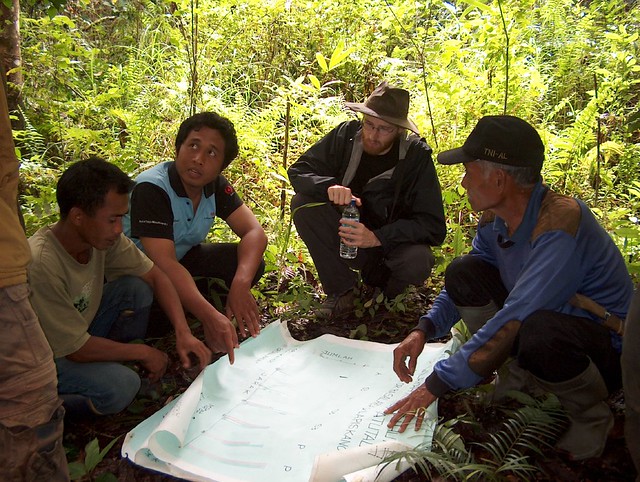
There's another paper out from the study of how Conservation by Design (CbD) 2.0 spread through TNC and beyond.
This paper (led by Yuta Masuda, I'm a co-author) focuses on "boundary spanners" - people with informal connections across departments / geography. These “boundary spanners” are four times more likely to spread information about “innovations” (here that means info about CbD 2.0) and to drive changes in attitude that encourage adoption. However, their advantage in spreading info only exists when they have <4 direct reports and are relatively low in the organizational hierarchy (counting levels of who reports to their direct reports etc. etc.).
There's a blog with more info at: https://www.sciencedaily.com/releases/2018/04/180409090127.htm and you can read the paper at http://rdcu.be/Kre4
Masuda, Y. J., Liu, Y., Reddy, S. M. W., Frank, K. A., Burford, K., Fisher, J. R. B., & Montambault, J. (2018). Innovation diffusion within large environmental NGOs through informal network agents. Nature Sustainability. https://doi.org/10.1038/s41893-018-0045-9
Thursday, March 1, 2018
March 2018 Science Journal Article Summary

Hi,
It has been a hectic month so I haven't read much science. I'm including two articles on beef sustainability (one exciting case study, and one much broader review), as well as a new paper of mine that was finally published after an epic 14 month review. My paper looks at how information about CbD 2.0 spread within TNC and beyond, and while it's long and dense I'd encourage you to at least check out the summary below for tips on how to aid "knowledge diffusion" and how to study it.
BEEF SUSTAINABILITY:
Stanley et al. 2018 is a paper arguing that proper grazing management may be able to make beef a net carbon sink. They don't go quite that far, but it's a reasonable extrapolation. While this is an encouraging case study and we should look carefully at how to apply it, there are some really important caveats to interpreting this more broadly. Specifically, they found using "adaptive multi-paddock (AMP)" grazing for the finishing phase of cattle instead of feeding them grain resulted in a sink of ~6.7 kg CO2e / kg carcass weight, compared to a source of ~6.1 kg CO2e / kg for feedlot beef. The study is designed well, and soil C improvements were measured empirically over 4 years, in three types of soil in the Upper Midwest. That being said, there are a few big issues that challenge the narrative of "carbon positive beef" being possible at wide scales:
- The soil sequestration here (3.6 Mg C / ha / yr) is much higher than is typically reported (although some studies have shown similar rates).
- These rates would diminish over time; it's not clear how fast the soil would saturate but high rates like this would be most likely in early years after improving management of highly degraded soils.
- This study was on alfalfa pasture (which fixes N); it's unlikely these results would apply to unfertilized rangelands
- The study did not include soil nitrous oxide emissions which are often substantial in leguminous pastures.
- Finally, the grass-finished beef took up twice as much space as the feedlot beef. That could be good from a perspective of prevent conversion of grasslands by keeping them in production, but it also means that if we scaled up grass-finished beef at this density, we'd have to find twice as much land to graze cattle on, which could drive conversion. It would also likely raise costs for producers and consumers.
Garnett et al. 2017 ("Grazed and Confused") is a very thoughtful review of the climate change / GHG impact of ruminants (largely cattle). Their first key findings is that even with good grazing ruminants still have high net GHG emissions. They also note sequestering soil carbon often has trade-offs with methane and nitrous oxide. Finally, as demand for animal protein rises sharply there is likely to be both land conversion and increasing GHGs as a result. These have all been reported widely in other studies, but it's a nice summary. On the one hand, it's hard to pull out quantitative results from this paper. On the other, it does a great job of covering the various arguments and counterpoints around cattle and carbon, and presenting the data in a value-neutral tone. Anyone interested in this topic should at least skim the 8-page summary.
KNOWLEDGE DIFFUSION:
Fisher et al. 2018 ("Knowledge diffusion within a large conservation organization and beyond") looks at how people find information about innovations and share them, specifically the spread of Conservation by Design 2.0 (CbD 2.0). We review how earlier versions of CbD spread from TNC (looking at published science articles and expert interviews), then use tons of varied data to look at CbD 2.0. I wrote a blog about the paper here: http://sciencejon.blogspot.com/2018/03/share-good-news-paper-on-improving.html
and the full paper is at: http://journals.plos.org/plosone/article?id=10.1371/journal.pone.0193716
but here's a summary of what we learned:
- Sending repeated broadly-targeted communications (e.g. all-staff email / newsletters / etc.) that make it easy for recipients to find out more worked better than more narrowly focused communications (e.g. plenary talks, emails from executives).
- Expert interviews revealed several factors to promote diffusion: bringing in partners early to develop and test methods, committing up front to sustain support for the planning methods, having in-person workshops, using peer-review and shared learning, providing financial support, explaining how the methods address existing needs planners already have, and the existence of a support and learning network like the conservation coaches network (CCNET).
- Organizations may wish to use internal data to identify staff likely to play a key role in diffusing so that they can encourage that process (the paper has details on how, with more forthcoming in an upcoming paper)
- Working with academics on publications represents a potential way to get the word out with relatively low effort for organizations (academics I have worked with in other contexts are often very interested in data no one else has access to, and have published cool papers from those data).
- For scientists interested in this topic, we learned a lot about how to study knowledge diffusion, and share tips for researchers (e.g. thinking about image-blocking, legal and privacy constraints, distinguishing internal and external website visits, etc.).
REFERENCES:
Fisher, J. R. B., Montambault, J., Burford, K. P., Gopalakrishna, T., Masuda, Y. J., Reddy, S. M. W., … Salcedo, A. I. (2018). Knowledge diffusion within a large conservation organization and beyond. PLoS ONE, 13(3), 1–24. https://doi.org/10.1371/journal.pone.0193716
Garnett T., Godde C., Muller A., Röös E., Smith P., de Boer I.J.M., Ermgassen E., Herrero M., van Middelaar C., Schader C. and van Zanten H. (2017). Grazed and confused? Ruminating on cattle, grazing systems, methane, nitrous oxide, the soil carbon sequestration question. Food Climate Research Network, University of Oxford http://www.fcrn.org.uk
Stanley, P. L., Rowntree, J. E., Beede, D. K., DeLonge, M. S., & Hamm, M. W. (2018). Impacts of soil carbon sequestration on life cycle greenhouse gas emissions in Midwestern USA beef finishing systems. Agricultural Systems, 162(November 2017), 249–258. https://doi.org/10.1016/j.agsy.2018.02.003
Share the good news: a paper on improving "knowledge diffusion"

Ever feel like you missed out on a super cool Kickstarter
project and you can’t believe no one told you about it? Amidst the fire hose of
blogs, podcasts, social media, and more, how can we help good ideas get
noticed, get shared, “go viral,” and make change happen?
That’s the question that a few scientists at The Nature
Conservancy (TNC) decided to tackle back in 2014 (http://blog.nature.org/science/2015/07/29/tracking-how-new-science-spreads/).
Scientists usually don’t get to tell others what to do, and we don’t have many
celebrity advocates or adorable cat videos to explain our research. So to
influence others we often have to be creative, “lead by intrigue,” and hope our
message catches on. But for a new idea to go viral, it helps to understand how
it spreads from person to person.
Our first journal article on this research (published in
PLoS ONE, http://journals.plos.org/plosone/article?id=10.1371/journal.pone.0193716)
taps into a huge array of different data sources including tracking web page
activity, TNC employee data, and more traditional detailed surveys to give us
some initial clues about how people are learning about innovations and sharing
them with others. Going this deep with different kinds of data to explore
diffusion is novel, and we learned some cool tricks other scientists may want
to use!
Scientists call the way that new ideas spread “diffusion of
innovations.” The process includes learning about and considering a new idea,
trying it out, and telling others about it (not necessarily in that order).
Some innovations are new technology or practices (e.g.,
seven science innovations changing conservation, http://blog.nature.org/science/2017/04/17/7-science-innovations-changing-conservation/).
We focused on a more conceptual example: the spread of the new scientific
principles and planning methodology at TNC: Conservation by Design AKA CbD, https://www.nature.org/science-in-action/conservation-by-design/index.htm.
We asked how TNC staff and others received this new information, sought to
learn more, and shared it.
CbD dates back 20 years and we saw lots of interest in it
from beyond TNC in published science articles. Experts we interviewed said that
ideas spread when you bring in partners early, invest in training and support,
and do several other things which TNC did from the beginning).

There were several other factors that made people more
likely to share information. Some were obvious, like people whose job included
training others in conservation planning methods. Others were less obvious,
e.g. people who took more online trainings (not limited to conservation) were
more likely to share information about CbD 2.0.
We also learned that even with all the data available to us,
there were still some surprising limitations. For example, Google Trends, much
touted as a “Big Data” approach to track public interest in different topics,
turned out to have unreliable data. Plus, it’s not specific enough: TNC’s
“conservation by design” gets searched for less than a private company with the
same name. So searches for “our” CbD got lost.
Most of my research tries to find how much information we
need to make the right decisions without wasting time on unnecessary analysis.
With the findings of this new paper, we have new insights into how we can share
those tips and avoid either wasting time or making the wrong call.
So the next time you miss out on that sweet Kickstarter
project, let me know, and let’s see if we can figure out how to better prepare
for the next one.
Fisher, J. R. B., Montambault, J., Burford, K. P., Gopalakrishna, T., Masuda, Y. J., Reddy, S. M. W., … Salcedo, A. I. (2018). Knowledge diffusion within a large conservation organization and beyond. PLoS ONE, 13(3), 1–24. https://doi.org/10.1371/journal.pone.0193716
Fisher, J. R. B., Montambault, J., Burford, K. P., Gopalakrishna, T., Masuda, Y. J., Reddy, S. M. W., … Salcedo, A. I. (2018). Knowledge diffusion within a large conservation organization and beyond. PLoS ONE, 13(3), 1–24. https://doi.org/10.1371/journal.pone.0193716
Subscribe to:
Posts (Atom)