Greetings,
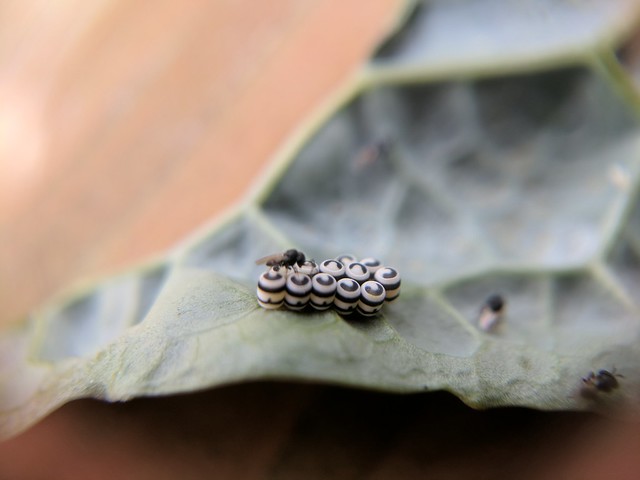
Here are some articles focused on pest control (the photo above is of harlequin bug eggs on kale), food safety, climate change, evidence, and even beer! Let me know if you need a copy of any of them. If you know someone who wants to sign up to receive these summaries, they can do so at http://bit.ly/sciencejon
CLIMATE CHANGE / NATURAL CLIMATE SOLUTIONS:
Almost everyone who works for or closely with The Nature Conservancy heard about the 2017 "Natural Climate Solutions" paper (Griscom et al. 2017, I reviewed it in November 2017). If you've been waiting for the sequel - good news! Fargione et al. 2018 just provided a similar analysis specifically for the United States. It's short, excellent, and worth reading, but if you're impatient skip to Figure 1. That summarizes the potential of each pathway and splits out how much is achievable at different carbon prices. They found a maximum potential of 1.2 Pg (aka 1200 million metric tons) CO2e / yr (21% of current US emissions and ~27% of 2005 emissions), and ~300 Tg (million metric tons) achievable at $10 / t CO2e (~5% of US emissions). The biggest low cost opportunities are in planting cover crops followed by forest management, avoided habitat conversion, and improved farm nutrient management. You can read more about it on TNC's web site at https://www.nature.org/en-us/explore/newsroom/natural-climate-solutions-study/ or at https://eurekalert.org/pub_releases/2018-11/cu-nsr111418.php
ORGANIC AGRICULTURE / FOOD SAFETY:
This is an interesting study on how consumption of organic vs. conventional foods affects cancer risk. They did find the people who ate the most organic food had 24% less cancer compared to the people who ate the least (even after controlling for quite a few lifestyle and diet variables, see Model 3 in Table 2). Unfortunately, they didn't test for pesticide residue (to confirm the hypothesis that pesticide was driving these results), there was a short follow-up time, they used a single unvalidated diet assessment, and there are enough odd findings (e.g. finding processed meat intake doesn't intake cancer risk) to make me suspect they didn't discover a causative relationship. I also don't understand how their model could find the organic diet has such a strong impact on cancer but then find that people eating a high quality diet AND lots of organic food didn't have reduced risk relative to those eating a low quality diet and little organic food (and supplemental table 6 looks like there IS a reduced risk although perhaps the confidence interval is too high to state it definitively). In short, this was an interesting paper but I don't think it is strong evidence for the conclusions they present. You can read a blog about this one at https://www.nytimes.com/2018/10/23/well/eat/can-eating-organic-food-lower-your-cancer-risk.html
EVIDENCE & DECISION MAKING:
To be effective in conservation, we need reliable evidence about the impact of different actions and strategies. This lets us focus on the strategies that will best help us reach our goals. Game et al. 2018 (led by TNC's Eddie Game) has timely guidance for how scientists should assess the quality of evidence (across multiple disciplines). They recommend beginning with a results chain to map out causal associations between actions, intermediate results, and outcomes, and then looking for the evidence of each link. They also note that in conservation a broader approach is needed than in other disciplines like medicine. The key point is the set of four principles they use to assess the strength of evidence. They are: variety (multiple types of evidence available), consistency (the evidence has consistent findings), credibility (the evidence comes from trusted sources), and applicability (the evidence matches the context of the issue being evaluated). You can read a blog about the paper at https://sustainabilitycommunity.nature.com/channels/1385-behind-the-paper/posts/38893-required-rethink-on-what-is-evidence
Bennett et al. 2018 is an attempt to make value of information (VOI) theory more practical. While still theoretical, they show how to apply VOI theory across multiple "management units." In each unit, the model compares two choices: acting with existing imperfect information, or doing more monitoring to support decision making. The revised model is a step forward, and I also enjoyed the discussion of limitations. For example, they mention that their model is risk neutral, which is often not the case with real decision makers.
CLIMATE CHANGE & BEER:
As we approach a major holiday season in the U.S., many people celebrate with alcohol. Xie et al. 2018 has a dire warning from the ghost of Christmas future: climate change may reduce barley yields (3-17%) and beer supply while driving up prices. Essentially they predict worsening drought and extreme heat will reduce barley production, and that during extreme years barley for beer will be reduced in favor of livestock feed and direct consumption. See Figure 3 for a nice summary of patterns of barley use by country now and under climate change. Some important limits: they don't predict future demand for beer (likely to increase), and they don't look at adaptation (e.g. making more beer w/ rice and corn as some major brewers do already, improved seed genetics, etc.). These caveats reinforce my skepticism of some predictions such as the price of beer in Ireland almost doubling (it's hard to imagine that could happen without a strong adaptive response). Nonetheless, most science predicting future food demand and supply focuses more on staples than luxuries, and this is an interesting twist.
REFERENCES:
Baudry, J., Ke, A., Touvier, M., Allès, B., Seconda, L., Latino-Martel, P., … Kesse-Guyot, E. (2018). Association of Frequency of Organic Food Consumption with Cancer Risk: Findings From the NutriNet-Santé Prospective Cohort Study. JAMA Internal Medicine. https://doi.org/10.1001/jamainternmed.2018.4357
Bennett, J. R., Maxwell, S. L., Martin, A. E., Chadès, I., Fahrig, L., & Gilbert, B. (2018). When to monitor and when to act: Value of information theory for multiple management units and limited budgets. Journal of Applied Ecology, 55(January), 2102–2113. https://doi.org/10.1111/1365-2664.13132
Deutsch, C. A., Tewksbury, J. J., Tigchelaar, M., Battisti, D. S., Merrill, S. C., Huey, R. B., & Naylor, R. L. (2018). Increase in crop losses to insect pests in a warming climate Downloaded from. Science, 361(August), 31. https://doi.org/10.1126/science.aat3466
Fargione, J. E., Bassett, S., Boucher, T., Bridgham, S. D., Conant, R. T., Cook-patton, S. C., … Griscom, B. W. (2018). Natural climate solutions for the United States. Science Advances, 4(November).
Game, E. T., Tallis, H., Olander, L., Alexander, S. M., Busch, J., Cartwright, N., … Sutherland, W. J. (2018). Cross-discipline evidence principles for sustainability policy. Nature Sustainability, 1(9), 452–454. https://doi.org/10.1038/s41893-018-0141-x
Karp, D. S., Chaplin-Kramer, R., Meehan, T., Martin, E., DeClerck, F., Grab, H., … Zou, Y. (2018). Crop pests and predators exhibit inconsistent responses to surrounding landscape composition. Proceedings of the National Academy of Sciences of the United States of America. https://doi.org/10.1073/pnas.1800042115
Waterfield, G., & Zilberman, D. (2012). Pest Management in Food Systems: An Economic Perspective. Annual Review of Environment and Resources, 37, 223–247. https://doi.org/10.1146/annurev-environ-040911-105628
Xie, W., Xiong, W., Pan, J., Ali, T., Cui, Q., Guan, D., … Davis, S. J. (2018). Decreases in global beer supply due to extreme drought and heat. Nature Plants. https://doi.org/10.1038/s41477-018-0263-1
Sincerely,
Jon
p.s. as a reminder, you can search all of the science articles written by TNC staff (that we know of) here http://www.conservationgateway.org/ConservationPlanning/ToolsData/sitepages/article-list.aspx
(as you publish please email science_pubs@tnc.org to help keep this resource current).
If you'd like to keep track of what I write as well as what I read, I always link to both my informal blog posts and my formal publications (plus these summaries) at http://sciencejon.blogspot.com/

