Hi there,
Here are some mixed articles focused on general conservation, global agriculture, no-till farming, and remote sensing. Let me know if you need a copy of any of them. If you know someone who wants to sign up to receive these summaries, they can do so at http://eepurl.com/diB0nr
Also for anyone attending TNC's Global Science Gathering in Houston - let me know if you'd like to join for a side meeting for scientists working on sustainable agriculture.
CONSERVATION (GENERAL):
For over a year now, TNC staff have been hearing about a science analysis asking whether it's possible for both people and nature to thrive (in a shared conservation vision). Tallis et al 2018 is the newly available science paper behind that analysis. It compares two 2050 global scenarios: business as usual (BAU), and one designed to improve human and environmental outcomes (Sustainability). The latter would result in 577 million ha more habitat than BAU, while limiting climate change, improving air quality, and more. It doesn't assume we can drastically change diets, and sticks with biophysical constraints, but it does recognize that there are major social, economic, and political barriers to making the sustainability scenario a reality. The discussion has several thoughtful limits and caveats, but it's still exciting to see what is at least possible, if not easy to achieve. You will have to read the supplemental material to get a good sense of the work, but the main paper is conveniently short. One final note is that they assume climate change won't impact ag much in either scenario, which is optimistic. You can read all about the paper and its findings here: https://www.nature.org/en-us/what-we-do/our-insights/perspectives/the-science-of-sustainability/?vu=r.v_twopaths
The Nature Conservancy has recently shifted priorities away from land protection in general, to focusing on larger areas (to reduce fragmentation and improve resilience). Armsworth et al. 2018 asks how that focus affects the ecological return on investment (ROI). They found that larger areas are the most efficient way to improve connectivity and reduce fragmentation, offering 2-3 times the ecological return compared to small sites (TNC can buy properties that are 10x the size for just 5x the cost). However, smaller areas offer 5-8 times the ecological ROI for the number of species protected. Optimizing for species persistence rather than simply presence again favors larger areas (although the authors caution that this finding may be an artefact). These findings aren't surprising, but they are an important reminder that protecting some small areas will likely be important to protect endemic species.
GLOBAL AGRICULTURE:
Springman et al. 2018 asks what it would take to sharply reduce the impact of global food production by 2050 (and stay within resource constraints) without simply offsetting impacts like GHGs through reforestation or other mitigation. They look at 3 options (diet change, tech and management, and reducing food waste) across 5 aspects: GHGs, fresh water use, land use, nitrogen, and phosphorous. They key finding is that no one category of solution is enough, and that for GHGs in particular major diet change (towards mostly plant based foods) would have to be part of the solution. Figure 3 summarizes this set of scenarios nicely. With their medium ambition scenario, they find halving food loss and waste improves impact 6-16% (relative to 2050), improving tech and management reduces impact 3-30%, and modest diet change improves 5-29% (see Figure 2), or they could all be combined for a 25-45% reduction. Note that their findings are global averages, and some places will deviate considerably (e.g. they find nuts and seeds don't account for much overall water use, but in places like California they have a big water footprint). Check the methods for country-level data. You can read two articles about this study here: https://www.washingtonpost.com/health/2018/10/10/how-will-or-billion-people-eat-without-destroying-environment/ and here: https://www.theguardian.com/environment/2018/oct/10/huge-reduction-in-meat-eating-essential-to-avoid-climate-breakdown
Pretty et al. 2018 has good news - they show improvements in global implementation of several forms of sustainable agricultural practices. They focus on practices that they see as representing "redesign" of agriculture as part of sustainable intensification or "SI" (offering yield and environmental benefits). This includes integrated pest management (IPM), conservation agriculture / soil health practices, and several others. They find some form of "SI" practices on 29% of global farms covering 9% of global agricultural land (crop and pasture). This shows progress is being made (although much remains to do). However, one caveat is not apparent in the paper: they define these practices as inherently intensifying or yield-promoting, but do NOT filter on farms where actual increases in yield have been measured. That's important as each of these practices has the potential to boost or reduce yield depending on how it's implemented, so it's unlikely that all of these farms actually represent true sustainable intensification. The lead author told me in a message that in developing nations would always be "win-win," and in more industrialized countries environmental benefits improved but yields could go up or down or stay the same.
Williams et al. 2018 is another paper on the land sparing vs. land sharing debate, focusing on carbon stocks. They use a mix of interviews and field data to model relationships between agricultural yield and above ground carbon, and then do a bit of modeling. They found that as crop yields go up, above ground carbon goes down (as expected). Nonetheless, across the landscapes they looked at, land sparing led to the most C stocks compared to land sharing or intermediate strategies. There are a few caveats which they helpfully admit to. First, results could vary for other environmental outcomes like water quality. They didn't look at social impacts (from either farms or ecosystem services from habitat). They don't look at methane or nitrous oxide, so for intense systems with inefficient fertilizer use the C benefit would be reduced. Finally, land sparing will not happen on its own - making farms more profitable gives them incentive to clear more habitat unless there are countervailing factors (e.g. zoning, taxes or penalties for clearing, incentives, etc.). You can read a blog about this one at https://www.npr.org/sections/thesalt/2018/08/03/634344754/which-vision-of-farming-is-better-for-the-planet
AGRICULTURE / NO-TILL:
Two recent papers (both Daryanto et al. 2017) find that no-till (NT) farming can increase the loss of nutrients under some conditions. They found that NT often increases loss of nitrate (NO3-) - generally there is similar or less runoff, but more leaching. But results vary across soil textures, climate, and crop management.
For phosphorous (P), overall NT led to lower nutrients ending up in aquatic ecosystems, and less particulate P export (except during wet years). But it increased dissolved P loss. There are lots of caveats and conditions on the results (e.g. no-till most effectively reduced particulate P from 0-3% slope, but on 4-9% slopes it actually increased P load), so it's worth reading the papers in full. A key finding of both papers is that NT has to be combined with other practices to be effective in reducing nutrient loss, that it doesn't work as well in dryland regions, and that NT benefits decrease over time so they recommend occasional tillage (once every ~10 years) despite likely tradeoffs in soil carbon. TNC’s Carrie Vollmer-Sanders has seen similar results for P. She recommends a focus on fertilizer placement (subsurface when possible), periodic tillage (every ~10 years), and strip tillage when it’s dry enough. There's a paper about the P results here: https://www.cornandsoybeandigest.com/fertilizer/no-till-benefits-challenged
REMOTE SENSING:
Seifert et al. 2018 has two parts: a remote sensing method to detect cover crops, and an analysis of their impact on crop yields. For remote sensing, "accuracy" is complicated but their method correctly identified whether or not cover crops were present 92% of the time, which is 68% better than expected by chance alone. They relied on readily available data, so this method should be applicable elsewhere. The second piece is that they found cover crops are grown on poor performing field (presumably in an effort to improve soils as they tended to be on poor soils). After a year of cover cropping corn yields went up on average by 0.65%, and soy by 0.35%, but read the results on p6 as there's a lot of variation (from long term cover crops reducing yields, or only improving after several years, etc., varying by state and crop). Hopefully making it easier to detect cover crops will improve our ability to understand their impacts.
If you've ever done remote sensing work in the tropics, you've noticed that you often want imagery when plants are growing, aka the rainy season when clouds limit available imagery. Pedraza et al. 2018 (from several TNC colleagues and their partners) uses radar data (ALOS PALSAR, which can see through clouds) to look for farm-level deforestation in Colombia. It worked reasonably well, mostly between 62% and 100% accurate: see table 4, focusing on user and producer accuracy as overally accuracy is skewed by the high proportion of nonforest. They found that accuracy was lower in dry forests and mountainous terrain, although they improved it by integrating some optical data. It's a useful paper for anyone looking at integrating radar data for tropical remote sensing.
REFERENCES:
Armsworth, P. R., Jackson, H. B., Cho, S. H., Clark, M., Fargione, J. E., Iacona, G. D., … Sutton, N. A. (2018). Is conservation right to go big? Protected area size and conservation return-on-investment. Biological Conservation, 225(November 2017), 229–236. https://doi.org/10.1016/j.biocon.2018.07.005
Daryanto, S., Wang, L., & Jacinthe, P.-A. (2017). Impacts of no-tillage management on nitrate loss from corn, soybean and wheat cultivation: A meta-analysis. Scientific Reports, 7(1), 12117. https://doi.org/10.1038/s41598-017-12383-7
Daryanto, S., Wang, L., & Jacinthe, P. A. (2017). Meta-analysis of phosphorus loss from no-till soils. Journal of Environmental Quality, 46(5), 1028–1037. https://doi.org/10.2134/jeq2017.03.0121
Pedraza, C., Clerici, N., Forero, C., Melo, A., Navarrete, D., Lizcano, D., … Galindo, G. (2018). Zero Deforestation Agreement Assessment at Farm Level in Colombia Using ALOS PALSAR. Remote Sensing, 10(9), 1464. https://doi.org/10.3390/rs10091464
Pretty, J., Benton, T. G., Bharucha, Z. P., Dicks, L. V, Flora, C. B., Godfray, H. C. J., … Wratten, S. (2018). Global assessment of agricultural system redesign for sustainable intensification. Nature Sustainability, 1(8), 441–446. https://doi.org/10.1038/s41893-018-0114-0
Seifert, C. A., Azzari, G., & Lobell, D. B. (2018). Satellite detection of cover crops and their effects on crop yield in the Midwestern United States. Environmental Research Letters, 13(6). https://doi.org/10.1088/1748-9326/aac4c8
Springmann, M., Clark, M., Mason-D’Croz, D., Wiebe, K., Bodirsky, B. L., Lassaletta, L., … Willett, W. (2018). Options for keeping the food system within environmental limits. Nature. https://doi.org/10.1038/s41586-018-0594-0
Tallis, H. M., Hawthorne, P. L., Polasky, S., Reid, J., Beck, M. W., Brauman, K., … McPeek, B. (2018). An attainable global vision for conservation and human well-being. Frontiers in Ecology and the Environment, 1–8. https://doi.org/10.1002/fee.1965
Williams, D. R., Phalan, B., Feniuk, C., Green, R. E., Williams, D. R., Phalan, B., … Balmford, A. (2018). Carbon Storage and Land-Use Strategies in Agricultural Landscapes across Three Continents. Current Biology, 28(15), 2500–2505. https://doi.org/10.1016/j.cub.2018.05.087
Sincerely,
Jon
p.s. as a reminder, you can search all of the science articles written by TNC staff (that we know of) here http://www.conservationgateway.org/ConservationPlanning/ToolsData/sitepages/article-list.aspx
(as you publish please email science_pubs@tnc.org to help keep this resource current).
If you'd like to keep track of what I write as well as what I read, I always link to both my informal blog posts and my formal publications (plus these summaries) at http://sciencejon.blogspot.com/
Showing posts with label cover crops. Show all posts
Showing posts with label cover crops. Show all posts
Thursday, November 1, 2018

Wednesday, April 11, 2018
April 2018 Science Journal Article Summary
Easter Greetings,
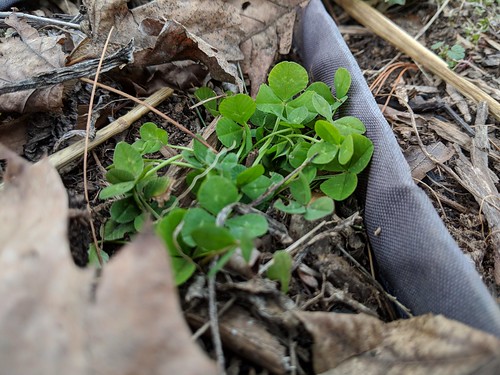
Farming is really hard! Cover crops (which cover farms after the primary crop is harvested) can offer benefits to both farmers and nature, but incorporating them is hard too. The photo above is the biggest patch of my attempted red clover cover crop in my tiny garden. So to get ready for the coming year, I've focused on several articles about cover crops, plus one new giant study on improving agriculture in China.
I can also finally share a book chapter I wrote 3 years ago which has languished "in press" after being accepted (it should be actually published late 2018). The first half is OK, but I'd skip to the 2nd half (start with the "Can Corporate Sustainability reporting be a force for improved agricultural practices?" section). There's some interesting content I haven't seen anywhere else on corporate sustainabiltiy and food labels. The chapter is available from: http://fish.freeshell.org/publications/FisherKareiva_CUP_2018_preformatted.pdf
Finally, fed up with people not finding your science journal articles, or having them inaccessible due to a paywall? I have answers to both problems in a new blog post: http://sciencejon.blogspot.com/2018/03/tips-for-helping-people-to-find-your.html
Let me know if you need a copy of any of the articles below.
AGRICULTURE (CHINA):
Cui et al 2018 reports on the results of an ambitious study that worked with 21 million farmers (!) of maize, rice, and wheat over 10 years. China currently has some of the least efficient farms in the world, presenting a huge need to improve. This study used a soil & crop management framework that resulted in ~11% improved yield while reducing N application by ~16% (and reactive N losses by ~25%), and GHGs by 14-22% depending on crop. The scale is impressive: altogether they influenced 37.7 million ha. Interestingly, extension staff impacted over 10 times the area per staff person (471 ha / person) compared to agribusiness partners (see Fig 2). Regardless, this is good news in showing that it's possible to achieve "win-win" outcomes at scale even with smallholders. On the other hand, nitrogen efficiency is so poor in China, that much larger changes are needed to bring them in line with world averages, let alone truly sustainable targets (highlighting that policy changes are likely needed as well). Fig 1 has a great breakdown of impacts by crop and region.
AGRICULTURE (COVER CROPS):
Why don't more farmers use cover crops? Roesch-McNally et al. 2017 asked them: what are the barriers, and how do cover crop users overcome them? Cover crops add complexity at very busy times for farmers, which is a key issue. They report concern about having time to plant cover crops in fall, and time to terminate them in spring without impacting cash crop planting. Lack of markets and equipment, narrow profits margins, and prevalence of rented land were also limiting. Farmers who overcame these barriers generally saw their farm as a "whole system" and were willing to experiment and modify other practices (e.g. tillage and fertilization). The authors wrap up by exploring several policy interventions (cost-sharing, new markets, promoting crop / livestock systems, and economic incentives).
Bergtold et al. 2017 dive more into the economic aspect of cover crops in Kansas (direct costs, indirect & opportunity costs, direct & indirect benefits, risk & crop insurance, and policy incentives). They find that on average cover crops will net farmers $7.04/ac on irrigated land, but cost them $28/ac on dryland (potentially $20/ac under less conservative assumptions). That difference is driven mainly by lower yields in drylands reducing the opportunity for a % boost in yield to add up to much. They honestly don't explain the rationale behind their calculations very well, so I wouldn't put too much stock in those specific numbers for net costs (and see Baschle below for different findings), but it's a useful reference for thinking through types of costs and benefits. It's long but even skimming the section headings will likely be informative.
Snapp et al. 2005 is a thoughtful review of cover crop benefits and costs, adding a key factor often overlooked. Different cover crops perform very differently in different contexts! The authors break down cover crop performance into USDA Hardiness Zone categories, and summer and winter crops. The whole article is a good resource, but I hadn't heard much about summer cover crops so was intrigued to read about their use to rehabilitate fields with poor performance. The main options were sorghum sudangrass and alfalfa in the north (although mixed grass-legume systems also show potential) and in the south sudangrass and a range of legumes (including pigeon pea, cowpea, and sunn hemp). This all reinforces the idea that cover crop selection is complicated and that a one size fits all approach won't work well.
Wilcoxen et al. 2018 (which includes TNC's Jeff Walk as a co-author) looks at a rarely studied aspect of cover crops: how do they impact birds? For both corn and soy, cover crops improved bird habitat / bird density. It's a small study and most fields were cereal rye, but their data seem to indicate the tall grass of rye was especially attractive. The authors note that terminating cover crops later would likely benefit birds, although as noted in the studies above that can prove challenging for farmers.
Basche et al. 2016 looks at how winter rye in the Midwestern US affects soil water capacity. The water paper asks whether cover crops reduce or improve water available for cash crops. They found the cover crop generally boosted plant water available to cash crops by ~21%, but did not impact crop yield (even during drought). At the end of p9 they have suggestions on how to manage cover crops to avoid water competition (e.g. terminate them early in dry years).
AGRICULTURE (SOIL HEALTH):
While not restricted to cover crops, Basche 2017 looks at how much different crop & grazing practices can affect water infiltration. Some of the recommendations aren't terribly practical currently, but Figure 3 shows which practices most consistently improve infiltration as a %, and Figure 4 shows which ones can lead to an absolute increase in infiltration of 1 inch during heavy rain storms. Cover crops were found to improve infiltration ~20-50%, and in about 1/3 of the studies that led to absorbing >1 inch of rain during heavy rain storms.
Woodard & Verteramo-Chiu look at how much better the Federal Crop Insurance Program (FCIP) could perform if it used soil data to establish rates and coverage. In other words, how could FCIP incentivize soil health practices that would reduce risks and costs of the program, while avoiding perverse incentives (e.g. in the past crop insurance was not available to farmers using cover crops). It's a fairly wonky economics paper, but they make a good case for much errors and bias exist in the current program. The key finding is that farms with high-quality soils are generally overpaying, and low-quality farms are underpaying. See Fig 3 for an example of how strong the pricing erors are (up to a factor of 6). By accounting for soils data (and perhaps current practices), this program could be an important driver to get farmers to start rebuilding healthier soils to keep premiums low. They focus on top corn producing states where soil quality is relatively homogeneous; benefits of accounting for soil should be higher in regions with more varied soil. With predicted volatility from climate change, improving crop insurance will be increasingly important.
REFERENCES:
Basche, A. D., Kaspar, T. C., Archontoulis, S. V., Jaynes, D. B., Sauer, T. J., Parkin, T. B., & Miguez, F. E. (2016). Soil water improvements with the long-term use of a winter rye cover crop. Agricultural Water Management, 172, 40–50. https://doi.org/10.1016/j.agwat.2016.04.006
Basche, A. (2017). Turning Soils into Sponges: How Farmers Can Fight Floods and Droughts. Retrieved from http://www.ucsusa.org/sites/default/files/attach/2017/08/turning-soils-into-sponges-full-report-august-2017.pdf
Bergtold, J. S., Ramsey, S., Maddy, L., & Williams, J. R. (2017). A review of economic considerations for cover crops as a conservation practice. Renewable Agriculture and Food Systems, 1–15. https://doi.org/10.1017/S1742170517000278
Cui, Z., Zhang, H., Chen, X., Zhang, C., Ma, W., Huang, C., … Dou, Z. (2018). Pursuing sustainable productivity with millions of smallholder farmers. Nature, 555, 363–366. https://doi.org/10.1038/nature25785
Roesch-McNally, G. E., Basche, A. D., Arbuckle, J. G., Tyndall, J. C., Miguez, F. E., Bowman, T., & Clay, R. (2017). The trouble with cover crops: Farmers’ experiences with overcoming barriers to adoption. Renewable Agriculture and Food Systems, 1–12. https://doi.org/10.1017/S1742170517000096
Snapp, S. S., Swinton, S. M., Labarta, R., Mutch, D., Black, J. R., Leep, R., … O’Neil, K. (2005). Evaluating Cover Crops for Benefits, Costs and Performance within Cropping System Niches. Agronomy Journal, 97, 322–332. https://doi.org/10.2134/agronj2005.0322
Wilcoxen, C. A., Walk, J. W., & Ward, M. P. (2018). Use of cover crop fields by migratory and resident birds. Agriculture, Ecosystems & Environment, 252, 42–50. https://doi.org/10.1016/j.agee.2017.09.039
Woodard, J. D., & Verteramo-Chiu, L. J. (2017). Efficiency impacts of utilizing soil data in the pricing of the federal crop insurance program. American Journal of Agricultural Economics, 99(3), 757–772. https://doi.org/10.1093/ajae/aaw099
Sincerely,
Jon
p.s. as a reminder, you can search all of the science articles written by TNC staff (that we know of) here http://www.conservationgateway.org/ConservationPlanning/ToolsData/sitepages/article-list.aspx
(as you publish please email science_pubs@tnc.org to help keep this resource current).
If you'd like to keep track of what I write as well as what I read, I always link to both my informal blog posts and my formal publications (plus these summaries) at http://sciencejon.blogspot.com/
Wednesday, November 9, 2016
reThink Soil: A Roadmap to U.S. Soil Health
We just released a new report on the potential benefits of adoption soil health practices in the U.S., and the conclusions are pretty exciting! You can read a brief overview, the executive summary, and the full paper at http://nature.org/soil. Much of the analysis was done by consultants we worked with, but I provided lots of scientific guidance and review throughout the process.

The web page has a good summary of some of the key points, but to put it even more succinctly, we argue that the adoption of three soil health practices (no-till, cover crops, and crop rotations) on U.S. row crops could have massive benefits both to society (e.g. improved water quality, reduced GHGs) and to the farmers implementing them (reduced soil erosion, improved soil quality and resilience).
For instance, if half of the farmland used to grow corn, soy, and wheat were to adopt all three practices, it could generate $7.4 billion in total benefits, and if all the farmland for those three crops adopted them it could be $19.6 billion (note that it's not double because some farms already use some of these practices). If you take the more optimistic upper range of our estimates, total societal benefit for 100% adoption of all three practices could be $49.8 billion. A lot of the science is uncertain, so these estimates are rough but we drew on the best available data to come up with them, and we are confident that the magnitude of the opportunity is valid even if the exact numbers are off.

The web page has a good summary of some of the key points, but to put it even more succinctly, we argue that the adoption of three soil health practices (no-till, cover crops, and crop rotations) on U.S. row crops could have massive benefits both to society (e.g. improved water quality, reduced GHGs) and to the farmers implementing them (reduced soil erosion, improved soil quality and resilience).
For instance, if half of the farmland used to grow corn, soy, and wheat were to adopt all three practices, it could generate $7.4 billion in total benefits, and if all the farmland for those three crops adopted them it could be $19.6 billion (note that it's not double because some farms already use some of these practices). If you take the more optimistic upper range of our estimates, total societal benefit for 100% adoption of all three practices could be $49.8 billion. A lot of the science is uncertain, so these estimates are rough but we drew on the best available data to come up with them, and we are confident that the magnitude of the opportunity is valid even if the exact numbers are off.
Subscribe to:
Posts (Atom)