Greetings,
Here is a short set of articles on potato cultivation, groundwater, and cattle and rangelands.
If you know someone who wants to sign up to receive these summaries, they can do so at http://eepurl.com/diB0nr
POTATO CULTIVATION:
Drakopolous et al. 2016 found that reduced tillage for potatoes led to 13% lower yields (smaller tubers) but also led to higher quality and nitrogen efficiency. The quality boost wasn't enough to offset yield loss and result in net economic benefit from reduced tillage.
Myrick 2016 is a masters thesis investigating adoption (and abandonment) of a potato variety resistant to late blight (C-88) in Yunnan, China. They found smaller farmers and those closer to cities were less likely to grow it, although they noted access to seed is very limited so decisions may largely be driven by which varieties extension agents promote. The appendix has some interesting (and at times, conflicting) data on farmer perceptions.
GROUNDWATER:
Jasechko et al. 2017 makes two important points about groundwater. The first is that between 42-85% of groundwater in the upper 1 km of the ground is over 12,000 years old, as is more than half the water pumped from deeper than 250m (highlighting challenges with pumping out "fossil" water which will be very slow to recharge). The other is that while the water is very old, half of the wells showed contamination with tritium (a radioactive isotope mostly present in the environment from nuclear weapons and testing, showing relatively recent contamination). In other words, groundwater which took millennia to recharge and get clean is being contaminated more rapidly.
You can read a blog about this one: http://www.bbc.com/news/science-environment-39715738
RANGELANDS / CATTLE / REMOTE SENSING:
Reeves and Baggett 2014 developed a relatively simple way to assess rangeland degradation using remote sensing. Essentially they compare rangelands to reference conditions (all rangelands within similar ecological classifications), and found relatively little degradation (with degradation trends almost undetectable). They list several reasons for this in the discussion, but from other work in this space I've read it seems that estimating grassland productivity and degradation remotely is fundamentally challenging and limited (especially without field data to calibrate on), and NDVI is not an ideal tool for grasslands for several reasons. Caution could be taken before assuming relatively simple remote sensing estimates of grassland condition are accurate and actionable.
Reeves et al. 2017 predicts how climate change will affect cattle in the western U.S., considering forage (quantity, interannual variability, and vegetation types) and hear stress. They expect more forage in the north, less woody plants and more grass (in general), more variation in forage quantity year to year, and more heat sress (starting 2020-2030), which taken together means more vulnerability of cattle in most places (especially in the Southwest). In northern areas, the impacts of heat stress are expected to offset the benefits of more forage (with some exceptions). The two top maps in Figure 3 has a good summary of net impacts on cattle by 2060 and 2100, with yellow to red indicating negative effects, and green to blue indicating positive ones.
REFERENCES:
Drakopoulos, D., Scholberg, J. M. S., Lantinga, E. A., & Tittonell, P. A. (2016). Influence of reduced tillage and fertilization regime on crop performance and nitrogen utilization of organic potato. Organic Agriculture, 6(2), 75–87. https://doi.org/10.1007/s13165-015-0110-x
Jasechko, S., Perrone, D., Befus, K. M., Bayani Cardenas, M., Ferguson, G., Gleeson, T., … Kirchner, J. W. (2017). Global aquifers dominated by fossil groundwaters but wells vulnerable to modern contamination. Nature Geoscience, (April), 1–6. https://doi.org/10.1038/ngeo2943
Myrick, S. N. B. (2016). An Economic Impact Assessment of Cooperation-88 Potato Variety in the Yunnan Province of China. Virginia Polytechnic Institute and State University.
Reeves, M. C., & Baggett, L. S. (2014). A remote sensing protocol for identifying rangelands with degraded productive capacity. Ecological Indicators, 43, 172–182. https://doi.org/10.1016/j.ecolind.2014.02.009
Reeves, M. C., Bagne, K. E., & Tanaka, J. (2017). Potential Climate Change Impacts on Four Biophysical Indicators of Cattle Production from Western US Rangelands. Rangeland Ecology and Management, 70(5), 529–539. https://doi.org/10.1016/j.rama.2017.02.005
Sincerely,
Jon
p.s. as a reminder, you can search all of the science articles written by TNC staff (that we know of) here http://www.conservationgateway.org/ConservationPlanning/ToolsData/sitepages/article-list.aspx
Showing posts with label China. Show all posts
Showing posts with label China. Show all posts
Monday, October 1, 2018

Monday, September 3, 2018
September 2018 science journal article roundup

Aloha,
This is the 50th of these science summaries, and somehow I am still not caught up with all the interesting papers I have! For that occasion, I'm tackling a number of papers that didn't group nicely but still looked relevant. So there are papers on GMOs, fertilization and nitrogen fixation, food security, and Chinese ag.
GMOs:
You've probably heard the debate about whether or not to label genetically engineered / modified food. On the one hand, consumers argue that food should be transparent about its origins to enable consumers to choose. The counterargument has been that since there isn't good evidence that GMOs can harm human health, it could result in consumers thinking it's being labeled b/c it's dangerous. But Kolodinsky and Lusk (2018) have some surprising good news - after GMO labels became mandatory in Vermont, consumer concern / opposition to GMOs actually went down (while in other states there was a non-significant small increase)! Figure 1 shows this graphically. However, after looking at Table 1 I'm less convinced as they have data for five points in time, and concern in the most recent data is about the same as the earliest data. So the finding could be an artifact of how they did their regression, but it's still a promising possibility worth looking into to better understand how these kinds of
labels may affect consumer beliefs.
Cheke 2018 is a commentary on how the use of pest control traits by GM crops can have unintended side-effects, just as traditional chemical pesticide use can. He presents brief interesting case studies, and essentially argues that we need long-term monitoring data to understand how novel forms of pest control impact target pests, non-target pests, and natural predators of pests. To be clear, this isn't an anti-GM paper, it just notes that switching from aerial sprays to toxins within the plant may have unintended consequences. See Zhang et al. 2018 under Chinese Agriculture below for more detail on Bt cotton as a case study.
FOOD SECURITY:
Hasegawa et al. 2018 is an analysis of how climate mitigation may impact food security. They find that climate mitigation may cause more hunger than the direct effects of climate change. Livestock in particular would be more expensive (given higher GHG emissions and land use). The primary drivers would be food price increases driven by: tax on GHG emissions, higher land rents if ag expansion is slowed, and land competition by biofuel. However, this outcome isn't inevitable if policy is crafted more carefully. For example, a tax focused on animal products could drive a shift to producing more food consumable directly by humans, and revenue could be used for food aid. The key questions are thinking about who will bear the costs of implementation, and how it may affect food prices and thus food security for poor people in particular.
AGRICULTURE / NITROGEN FIXATION / FERTILIZER:
Van Deynze et al 2018 has been getting lots of press. The authors describe a landrace (local cultivar) of maize in Mexico that can fix its own nitrogen via microbes that hang out in aerial roots covered in goopy sugary mucilage. The authors did isotope tracing to verify that N was coming from the air and entering the aerial roots. Since corn uses tons of fertilizer, having it make its own sounds pretty exciting. In this case, it allows corn to be grown in nitrogen-depleted fields in Mexico, with ~30-80% of needed nitrogen coming from the air (varying by field and growth stage, but often ~50%). Unfortunately, this type of N-fixation is not as efficient as how legumes do it, and N-fixing maize is not brand new (Steve Wood sent me this paper from 1975 on the topic: http://www.pnas.org/content/72/6/2389.short). But (as Steve also pointed out) this is a pretty understudied area and there's a lot we don't know about the potential, which if nothing else shows the value in promoting crop diversity
so we don't lose potentially useful varities like this!
See https://news.wisc.edu/corn-that-acquires-its-own-nitrogen-identified-reducing-need-for-fertilizer/ for a blog post on this research.
Given how much research there is on trying to get crops to fix their own nitrogen, the finding by Griesmann et al. 2018 that many plants have lost the ability to fix N blew my mind. By comparing genomes of N-fixing plants to those that don't, they were able to find that ~3/4 of the species in their sample that didn't fix N had an ancestor that could! They suggest that the fact this ability has been lost multiple times reflects that plants spend a lot of energy to support N fixation, and that when N levels are adequate in the soil they eventually can lose the ability to fix it. In other words, as we try to engineer plants to fix their own N, it's worth reflecting on the costs that may have led plants in the past to reject this evolutionary path.
There's a blog on this one at http://www.sciencemag.org/news/2018/05/many-plants-need-bacterial-roommates-survive-so-why-do-some-kick-them-out
Chen et al. 2018 takes a different approach to improving fertilizer use in ag. They provide a review of possible ways to improve the environmental impacts of making chemical nitrogenous fertilizer. Currently the Haber-Bosch process relies on methane, so getting hydrogen from water instead could have many benefits if the higher energy cost can be overcome. This is a pretty technical paper but the first page is an overview that is much more accessible and introduces the possibilities.
CHINESE AGRICULTURE:
Zuo et al 2018 is a nice dense analysis of how Chinese agriculture has changed over the past ~20 years, focusing on crop yield and five environmental indicators (irrigation water, excess N, excess P, land use, and GHGs). While total crop calories produced increased by 66% (with only 1% more net land use), and environmental intensity (impact per calorie) went down, the total environmental impact still worsened quite a bit. This is a common challenge in sustainable intensification - it's often relatively easy to boost yields, but challenging to reduce actual impacts to the environment at the same time. The authors also note that urbanization has pushed cropland to more marginal and water-scarce areas, and future shifts in cropland may pose further challenges. This is worth reading in its entirety for anyone working in Chinese ag, but Table 1 summarizes the changes well, and Figure 3 is an intriguing map with potential priority areas to focus on different indicators.
Zhang et al. 2018 is a look at the impacts of planting Bt cotton (genetically engineered to produce the Bt toxin) in China on three major pests, and how that relates to farm management and nearby land use. The good news is that the use of Bt cotton decreased spraying for bollworm, which in turn allowed natural predators of aphids to recover (which reduced aphid population). Unfortunately, the reduced spraying also allowed mirid bugs to increase. Figure 3 shows how the infestations and spraying changed over time as Bt cotton was rolled out. These trade-offs show the need to think holistically about pest control. Farms in landscapes with more non-farm land use (urban, water, forest, grass, 'unused') had less aphids and mirid bugs (but bollworms were unaffected, and other research has found diverse land use may promote mirid bugs). Finally, farmers were found to spray for aphids and bollwords at non-damaging levels, which represents a missed opportunity to increase their profits (via reduced
costs) and improve their sustainability.
REFERENCES:
Cheke, R. A. (2018). New pests for old as GMOs bring on substitute pests. Proceedings of the National Academy of Sciences, 201811261. https://doi.org/10.1073/pnas.1811261115
Chen, J. G., Crooks, R. M., Seefeldt, L. C., Bren, K. L., Bullock, R. M., Darensbourg, M. Y., … Schrock, R. R. (2018). Beyond fossil fuel–driven nitrogen transformations. Science, 360(6391), eaar6611. https://doi.org/10.1126/science.aar6611
Griesmann, M., Chang, Y., Liu, X., Song, Y., Haberer, G., Crook, M. B., … Cheng, S. (2018). Phylogenomics reveals multiple losses of nitrogen-fixing root nodule symbiosis. Science, 361(6398). https://doi.org/10.1126/science.aat1743
Hasegawa, T., Fujimori, S., Havlík, P., Valin, H., Bodirsky, B. L., Doelman, J. C., … Witzke, P. (2018). Risk of increased food insecurity under stringent global climate change mitigation policy. Nature Climate Change, 8(8), 699–703. https://doi.org/10.1038/s41558-018-0230-x
Kolodinsky, J., & Lusk, J. L. (2018). Mandatory Labels can Improve Attitudes toward Genetically Engineered Food. Science Advances, In press(June), 1–6. https://doi.org/10.1126/sciadv.aaq1413
Van Deynze, A., Zamora, P., Delaux, P., Heitmann, C., Jayaraman, D., Rajasekar, S., … Bennett, A. B. (2018). Nitrogen fixation in a landrace of maize is supported by a mucilage-associated diazotrophic microbiota. PLOS Biology, 16(8), e2006352. https://doi.org/10.1371/journal.pbio.2006352
Zhang, W., Lu, Y., Werf, W. Van Der, Huang, J., Wu, F., Zhou, K., & Deng, X. (2018). Multidecadal, county-level analysis of the effects of land use, Bt cotton, and weather on cotton pests in China. Proceedings of the National Academy of Sciences. https://doi.org/10.1073/pnas.1721436115
Zuo, L., Zhang, Z., Carlson, K. M., MacDonald, G. K., Brauman, K. A., Liu, Y., … West, P. C. (2018). Progress towards sustainable intensification in China challenged by land-use change. Nature Sustainability, 1(6), 304–313. https://doi.org/10.1038/s41893-018-0076-2
Wednesday, April 11, 2018
April 2018 Science Journal Article Summary
Easter Greetings,
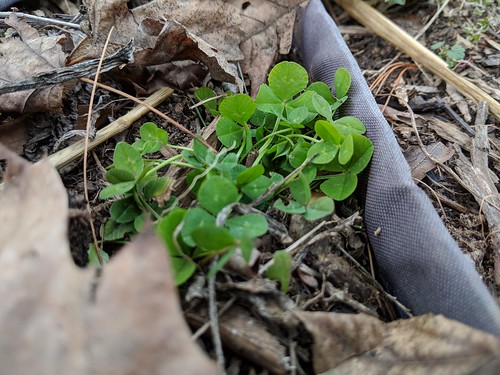
Farming is really hard! Cover crops (which cover farms after the primary crop is harvested) can offer benefits to both farmers and nature, but incorporating them is hard too. The photo above is the biggest patch of my attempted red clover cover crop in my tiny garden. So to get ready for the coming year, I've focused on several articles about cover crops, plus one new giant study on improving agriculture in China.
I can also finally share a book chapter I wrote 3 years ago which has languished "in press" after being accepted (it should be actually published late 2018). The first half is OK, but I'd skip to the 2nd half (start with the "Can Corporate Sustainability reporting be a force for improved agricultural practices?" section). There's some interesting content I haven't seen anywhere else on corporate sustainabiltiy and food labels. The chapter is available from: http://fish.freeshell.org/publications/FisherKareiva_CUP_2018_preformatted.pdf
Finally, fed up with people not finding your science journal articles, or having them inaccessible due to a paywall? I have answers to both problems in a new blog post: http://sciencejon.blogspot.com/2018/03/tips-for-helping-people-to-find-your.html
Let me know if you need a copy of any of the articles below.
AGRICULTURE (CHINA):
Cui et al 2018 reports on the results of an ambitious study that worked with 21 million farmers (!) of maize, rice, and wheat over 10 years. China currently has some of the least efficient farms in the world, presenting a huge need to improve. This study used a soil & crop management framework that resulted in ~11% improved yield while reducing N application by ~16% (and reactive N losses by ~25%), and GHGs by 14-22% depending on crop. The scale is impressive: altogether they influenced 37.7 million ha. Interestingly, extension staff impacted over 10 times the area per staff person (471 ha / person) compared to agribusiness partners (see Fig 2). Regardless, this is good news in showing that it's possible to achieve "win-win" outcomes at scale even with smallholders. On the other hand, nitrogen efficiency is so poor in China, that much larger changes are needed to bring them in line with world averages, let alone truly sustainable targets (highlighting that policy changes are likely needed as well). Fig 1 has a great breakdown of impacts by crop and region.
AGRICULTURE (COVER CROPS):
Why don't more farmers use cover crops? Roesch-McNally et al. 2017 asked them: what are the barriers, and how do cover crop users overcome them? Cover crops add complexity at very busy times for farmers, which is a key issue. They report concern about having time to plant cover crops in fall, and time to terminate them in spring without impacting cash crop planting. Lack of markets and equipment, narrow profits margins, and prevalence of rented land were also limiting. Farmers who overcame these barriers generally saw their farm as a "whole system" and were willing to experiment and modify other practices (e.g. tillage and fertilization). The authors wrap up by exploring several policy interventions (cost-sharing, new markets, promoting crop / livestock systems, and economic incentives).
Bergtold et al. 2017 dive more into the economic aspect of cover crops in Kansas (direct costs, indirect & opportunity costs, direct & indirect benefits, risk & crop insurance, and policy incentives). They find that on average cover crops will net farmers $7.04/ac on irrigated land, but cost them $28/ac on dryland (potentially $20/ac under less conservative assumptions). That difference is driven mainly by lower yields in drylands reducing the opportunity for a % boost in yield to add up to much. They honestly don't explain the rationale behind their calculations very well, so I wouldn't put too much stock in those specific numbers for net costs (and see Baschle below for different findings), but it's a useful reference for thinking through types of costs and benefits. It's long but even skimming the section headings will likely be informative.
Snapp et al. 2005 is a thoughtful review of cover crop benefits and costs, adding a key factor often overlooked. Different cover crops perform very differently in different contexts! The authors break down cover crop performance into USDA Hardiness Zone categories, and summer and winter crops. The whole article is a good resource, but I hadn't heard much about summer cover crops so was intrigued to read about their use to rehabilitate fields with poor performance. The main options were sorghum sudangrass and alfalfa in the north (although mixed grass-legume systems also show potential) and in the south sudangrass and a range of legumes (including pigeon pea, cowpea, and sunn hemp). This all reinforces the idea that cover crop selection is complicated and that a one size fits all approach won't work well.
Wilcoxen et al. 2018 (which includes TNC's Jeff Walk as a co-author) looks at a rarely studied aspect of cover crops: how do they impact birds? For both corn and soy, cover crops improved bird habitat / bird density. It's a small study and most fields were cereal rye, but their data seem to indicate the tall grass of rye was especially attractive. The authors note that terminating cover crops later would likely benefit birds, although as noted in the studies above that can prove challenging for farmers.
Basche et al. 2016 looks at how winter rye in the Midwestern US affects soil water capacity. The water paper asks whether cover crops reduce or improve water available for cash crops. They found the cover crop generally boosted plant water available to cash crops by ~21%, but did not impact crop yield (even during drought). At the end of p9 they have suggestions on how to manage cover crops to avoid water competition (e.g. terminate them early in dry years).
AGRICULTURE (SOIL HEALTH):
While not restricted to cover crops, Basche 2017 looks at how much different crop & grazing practices can affect water infiltration. Some of the recommendations aren't terribly practical currently, but Figure 3 shows which practices most consistently improve infiltration as a %, and Figure 4 shows which ones can lead to an absolute increase in infiltration of 1 inch during heavy rain storms. Cover crops were found to improve infiltration ~20-50%, and in about 1/3 of the studies that led to absorbing >1 inch of rain during heavy rain storms.
Woodard & Verteramo-Chiu look at how much better the Federal Crop Insurance Program (FCIP) could perform if it used soil data to establish rates and coverage. In other words, how could FCIP incentivize soil health practices that would reduce risks and costs of the program, while avoiding perverse incentives (e.g. in the past crop insurance was not available to farmers using cover crops). It's a fairly wonky economics paper, but they make a good case for much errors and bias exist in the current program. The key finding is that farms with high-quality soils are generally overpaying, and low-quality farms are underpaying. See Fig 3 for an example of how strong the pricing erors are (up to a factor of 6). By accounting for soils data (and perhaps current practices), this program could be an important driver to get farmers to start rebuilding healthier soils to keep premiums low. They focus on top corn producing states where soil quality is relatively homogeneous; benefits of accounting for soil should be higher in regions with more varied soil. With predicted volatility from climate change, improving crop insurance will be increasingly important.
REFERENCES:
Basche, A. D., Kaspar, T. C., Archontoulis, S. V., Jaynes, D. B., Sauer, T. J., Parkin, T. B., & Miguez, F. E. (2016). Soil water improvements with the long-term use of a winter rye cover crop. Agricultural Water Management, 172, 40–50. https://doi.org/10.1016/j.agwat.2016.04.006
Basche, A. (2017). Turning Soils into Sponges: How Farmers Can Fight Floods and Droughts. Retrieved from http://www.ucsusa.org/sites/default/files/attach/2017/08/turning-soils-into-sponges-full-report-august-2017.pdf
Bergtold, J. S., Ramsey, S., Maddy, L., & Williams, J. R. (2017). A review of economic considerations for cover crops as a conservation practice. Renewable Agriculture and Food Systems, 1–15. https://doi.org/10.1017/S1742170517000278
Cui, Z., Zhang, H., Chen, X., Zhang, C., Ma, W., Huang, C., … Dou, Z. (2018). Pursuing sustainable productivity with millions of smallholder farmers. Nature, 555, 363–366. https://doi.org/10.1038/nature25785
Roesch-McNally, G. E., Basche, A. D., Arbuckle, J. G., Tyndall, J. C., Miguez, F. E., Bowman, T., & Clay, R. (2017). The trouble with cover crops: Farmers’ experiences with overcoming barriers to adoption. Renewable Agriculture and Food Systems, 1–12. https://doi.org/10.1017/S1742170517000096
Snapp, S. S., Swinton, S. M., Labarta, R., Mutch, D., Black, J. R., Leep, R., … O’Neil, K. (2005). Evaluating Cover Crops for Benefits, Costs and Performance within Cropping System Niches. Agronomy Journal, 97, 322–332. https://doi.org/10.2134/agronj2005.0322
Wilcoxen, C. A., Walk, J. W., & Ward, M. P. (2018). Use of cover crop fields by migratory and resident birds. Agriculture, Ecosystems & Environment, 252, 42–50. https://doi.org/10.1016/j.agee.2017.09.039
Woodard, J. D., & Verteramo-Chiu, L. J. (2017). Efficiency impacts of utilizing soil data in the pricing of the federal crop insurance program. American Journal of Agricultural Economics, 99(3), 757–772. https://doi.org/10.1093/ajae/aaw099
Sincerely,
Jon
p.s. as a reminder, you can search all of the science articles written by TNC staff (that we know of) here http://www.conservationgateway.org/ConservationPlanning/ToolsData/sitepages/article-list.aspx
(as you publish please email science_pubs@tnc.org to help keep this resource current).
If you'd like to keep track of what I write as well as what I read, I always link to both my informal blog posts and my formal publications (plus these summaries) at http://sciencejon.blogspot.com/
Thursday, February 1, 2018
February 2018 Science Journal Article Summary

Greetings,
The struggle to find good produce in the depth of winter (see my sad kale above) has me thinking about nutrients, so this month I've focused on papers about nutrients in the sense of fertilizer on croplands (focused on N & P, plus one about crop nutrition).
Interested in short blogs or talks? I have a new blog connecting the story of my family's farm with my work on scaling sustainable agriculture. The blog is at https://blog.nature.org/science/2018/01/25/scaling-sustainable-agriculture/ and was adopted from my "TED-style" talk: https://www.youtube.com/watch?v=EPDBKJj_fSo. Here's another with the "so what" that was missing from my recent book chapter on global agriculture land use trends. http://sciencejon.blogspot.com/2018/01/take-2-what-i-wish-id-put-in-my-recent.html
Finally: unrelated to science, I was impressed how much the Engaging Across Differences has jump-started the way I think about and engage around diversity. They're looking for people to sign up for the next workshops, and I'd encourage all TNC staff to give it serious thought. Let me know if you'd like to discuss further; it's led me to co-host an ongoing workshop at our headquarters about how we can all step up and be better allies to each other.
AGRICULTURE (NITROGEN): The first three papers all come from Xin Zhang at China Agricultural University in Beijing.
Zhang et al 2015 (in Nature) looks at global historic patterns of nitrogen fertilizer use and efficiency, identifying opportunities for improvement. Optimizing nitrogen use efficiency (NUE) means avoiding N loss to the air and water, but also ensuring crops have enough N. Start with Table 1 - which highlights the severe (and worsening) excess in India and China, driven partly by low subsidized fertilizer prices. Fig 4 is also really interesting - it compares efficency in the US and China, partly due to efficiency, and partly due to what we grow (e.g. in the US we grow a lot of soy that doesn't need N).
The other Zhang et al 2015 article (in JEQ) looks at how the economics of promoting technology and best management practices to improve nitrogen use efficiency (NUE) on farms. They model different kinds of improvements, whether they maintain yields at a lower input rate, improve yields at a similar input rate, or improve yields but require more fertilizer as well (e.g. by improving crop genetics). It's a cool (albeit wonky) paper, and Figures 4-7 explore the conditions under which implementing these practices can boost both profit and environmental outcomes. Table 4 shows that for Midwestern corn, at relatively high fertilizer prices improved genetics can be the best strategy, while at lower prices other approaches perform better (with changing the crop running the risk of environmental harm from excess nitrogen). They conclude with policy recommendations around how shifting from subsidies for fertilizer to subsidies for improved practices can help improve NUE. Table 6 has guidelines on how to find the optimal price ranges for both fertilizer and BMPs. A final twist: practices that don't boost yield are less likely to be adopted (even if they save cost), while yield-boosting practices are more appealing but also run more risk of excess N being lost.
Zhang et al. 2017 has some good news in the form of a case study in Huantai county in northern China. While China's overall NUE has gotten worse over the past several decades, it has improved in Huantai. Primary drivers appear to be incorporation of crop straw into soil, and subsidized mechanization of farmland in the area. Overuse of groundwater for irrigation, however, remains a major challenge. Nonetheless, this provides a road map for how the rest of China may be able to follow suit.
Wagner-Riddle et al. 2017 looks specifically at the importance of soil freezing and thawing in correctly estimating N2O emissions. Essentially, when frozen soil thaws, it emits a lot more N2o (a potent greenhouse gas). They estimate that global N2O emissions from cropland may be 17-28% too low due to neglecting to account for soil freezing and thawing.
Sweeney 2017 is another paper finding that long term no-till redistributes soil carbon to the surface but doesn't boost total soil carbon (this case was a claypan soil). More oddly, they found tillage and N fertilization didn't impact soil bulk density or resistance.
AGRICULTURE (phosphorous): The next two articles are cited in this blog about phosphorous (P) in Lake Erie (thanks to Joe F for passing it on, and to Carrie V-S for following up): https://blogs.nicholas.duke.edu/citizenscientist/phosphorus-in-lake-erie/
Christianson et al. 2016 is a review of phosphorous being lost via farm drainage, both subsurface (tile) drains and surface drains like ditches. There is a lot of interesting data packed in here, but three things jumped out at me. First is that overall P loads were higher in surface drainage than subsurface drainage (Fig 2). The other was that no-till fields lost about triple the P compared to conventional or even conservation tillage. So no-till may reduce sediment losses but increase P losses, presenting an interesting trade-off. Third is that P losses tend to be relatively small (<5% applied) compared to N losses (~15-20%), which reduces the economic incentive for farmers to address P loss.
Jarvie et al. 2017 looked at soluble reactive phosphorous (SRP) in the Western Lake Erie Basin, and looked for correlations with changing agricultural practices. They had data for changes in tillage, and used changing "flashiness" of river flow as a proxy for increased drainage. They note that many factors could have caused the increasing river SRP loads, but attribute 1/3 to increased drainage water flow and 2/3 to an increase in SRP delivery. They concluded that no-till and drainage were both likely responsible for the increasing SRP delivery, but I'm not convinced. Figure 3 and Table 4 show that across the three studied rivers there was not a clear relationship between tillage and drainage and SRP.
AGRICULTURE (nutrition):
I had a few people mention stories about Myers et al 2014 recently about how climate change will impact crop nutrition. This study found that CO2 levels of ~550ppm (which we will likely hit in ~50 years) zinc and iron levels will be lower in wheat, rice, peas, and soy (and wheat and rice having lower protein as well). The decreases are modest; the biggest decline was in wheat, with 9% lower zinc and 5% less iron. This is a legitimate concern (albeit a minor one), but what I find most interesting is how people I spoke to thought the results were much worse. One person told me that even now (not 50 years away) even healthy foods like kale were basically junk food, another thought we were already seeing nutrient deficiencies because of this. So, let's watch out for how climate is changing nutrient density, but in the meantime, keep loading up on those collard greens! If you're worried about zinc and iron there are some great options like pumpkin seeds and sesame seeds. You can read a story about this at https://news.nationalgeographic.com/news/2014/05/140507-crops-nutrition-climate-change-carbon-dioxide-science/ and the full article at https://www.nature.com/articles/nature13179.epdf?referrer_access_token=76wOkmaasSrVgR9Mzrl9ltRgN0jAjWel9jnR3ZoTv0PMO7CPYghaROZ8qcdXJ1XpBQ-HSZ0qsiW_gsnZNm-k2tQbZpybQuj_TyTm_QE_T7II9y4nRL-jY0UkROfWdT1gnDq8RPHQf8p05_0tlFvHfeU6vWI1uWKmjMIFQ4iSJEGlh4PO6nfwfm-1i-9N-5wi&tracking_referrer=news.nationalgeographic.com
REFERENCES:
Christianson, L. E., Harmel, R. D., Smith, D., Williams, M. R., & King, K. (2016). Assessment and Synthesis of 50 Years of Published Drainage Phosphorus Losses. Journal of Environment Quality, 45(5), 1467. https://doi.org/10.2134/jeq2015.12.0593
Jarvie, H. P., Johnson, L. T., Sharpley, A. N., Smith, D. R., Baker, D. B., Bruulsema, T. W., & Confesor, R. (2017). Increased Soluble Phosphorus Loads to Lake Erie: Unintended Consequences of Conservation Practices? Journal of Environment Quality, 46(1), 123. https://doi.org/10.2134/jeq2016.07.0248
Myers, S. S., Zanobetti, A., Kloog, I., Huybers, P., Leakey, A. D. B., Bloom, A. J., … Usui, Y. (2014). Increasing CO2 threatens human nutrition. Nature, 510, 139. Retrieved from http://dx.doi.org/10.1038/nature13179
Sweeney, D. W. (2017). Does 20 Years of Tillage and N Fertilization Influence Properties of a Claypan Soil in the Eastern Great Plains? Agricultural & Environmental Letters, 2(1), 0. https://doi.org/10.2134/ael2017.08.0025
Wagner-Riddle, C., Congreves, K. A., Abalos, D., Berg, A. A., Brown, S. E., Ambadan, J. T., … Tenuta, M. (2017). Globally important nitrous oxide emissions from croplands induced by freeze–thaw cycles. Nature Geoscience, 10(March). https://doi.org/10.1038/ngeo2907
Zhang, X., Davidson, E. A., Mauzerall, D. L., Searchinger, T. D., Dumas, P., & Shen, Y. (2015). Managing nitrogen for sustainable development. Nature, 528(7580), doi:10.1038/nature15743. https://doi.org/10.1038/nature15743
Zhang, X., Mauzerall, D. L., Davidson, E. a, Kanter, D. R., & Cai, R. (2015). The economic and environmental consequences of implementing nitrogen-efficient technologies and management practices in agriculture. Journal of Environmental Quality, 44(2), 312–24. https://doi.org/10.2134/jeq2014.03.0129
Zhang, X., Bol, R., Rahn, C., Xiao, G., Meng, F., & Wu, W. (2017). Agricultural sustainable intensification improved nitrogen use efficiency and maintained high crop yield during 1980–2014 in Northern China. Science of The Total Environment, 596–597, 61–68. https://doi.org/10.1016/j.scitotenv.2017.04.064
Subscribe to:
Posts (Atom)