Showing posts with label publications. Show all posts

Sunday, January 18, 2026

New paper - Rapid Evidence Assessments

A new paper I'm a co-author on just came out in Conservation Letters:

A Standardized Definition of Rapid Evidence Assessment for Environmental Applications

At it's heart, the paper proposes a consensus definition of what should count as a "rapid evidence assessment" (or REA) in conservation. It was hard to develop over several virtual workshops, because we had very different perspectives! The basic idea was that it can be hard to find the sweet spot when doing a literature review or evidence assessment. Too quick and dirty, and you can come to faulty conclusions by misunderstanding what evidence exists and what it says. But too complex and rigorous and the results may 1) come too late to be useful and 2) take a lot of resources that could be spent on multiple smaller studies.

For the few of us who work at conservation nonprofits, we saw systematic reviews as a typically unattainable gold standard, and we see a lot of informal "literature scans" when time is really scarce even though we know there are important limits and downsides. But for some of the academics, what looked very rigorous to the nonprofit scientists didn't look rigorous enough to count as a "rapid evidence assessment." For example, in one moment another participant suggested that surely we would all agree a literature review done via Google Scholar was impermissibly flawed and should be excluded. But almost all of my peer-reviewed publications had literature reviews done via Google Scholar! So in the end we settled on a definition where "rapid" is relative to systematic reviews.

The paper has our final definition, recommended steps for a REA, and Table 1 has a nice little guide to picking what level of rigor may be the best fit in different circumstances. Take a look!

https://conbio.onlinelibrary.wiley.com/doi/10.1111/con4.70005 

Monday, October 11, 2021

Wildhub interview on publishing and science communications

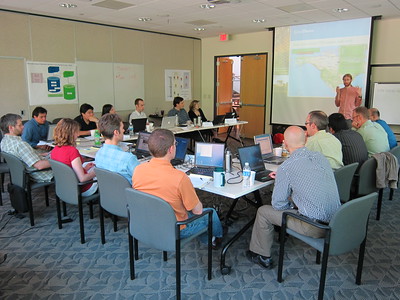
Spatial Data Publishing Workshop

I was recently interviewed for Wildhub (a member-led website where conservation professionals from around the world can post) about scientific publishing and communications. 

We talked about how publishing can be important, why we wrote the paper on how scientists can improve their impact, challenges in writing that paper, finding co-authors, dealing with criticism and rejection, and the importance of persisting in sharing your message.

Friday, March 16, 2018

Tips for helping people to find your journal articles (and be able to read them)

After years of working on a project and getting it accepted for publication at a journal, it can be heartbreaking when no one reads it.

The two biggest barriers are usually: finding out about it, and having it behind a paywall. Since open-source publishing usually costs extra, I don't always have funding to do it. But here are tips on overcoming both barriers.

Helping people discover that your article exists:
People mostly find my research either through Google Scholar or Researchgate, although occasionally ORCID brings people in. Researchgate is easy to edit manually to add entries (but don't upload the full-text there publicly, see the section below for important legal considerations), and both ORCID and Google Scholar do a good job pulling articles directly from the journals (usually within a few weeks of publication). However! If ORCID or Google Scholar is missing any of your research you think should be listed, you can manually add entries there too (in Google go to your profile and hit the gray + above the list of articles, in ORCID hit "+ add works"). Note that blogs and other non-peer-reviewed sources will show up in Google Scholar if someone cites the source.

That helps scientists find your articles. But for anything you really hope will have an impact, sit down and make a communications plan, ideally when you're first designing the research in conjunction with key stakeholders and communications experts. Who do you hope will read the article, and what do you hope they will do as a result? Once you have your key audiences, consider whether writing a blog or two would help get people get interested (and get clear on the point of the paper), and enlist help in getting the message to the right people. The reason doing this early is so important is that you may actually write a different paper once you know what your intended audience currently thinks and cares about, and what may motivate them to take action.

OK, hopefully you've verified your research is all discoverable, but what if people want to actually read it? Most journals don't let you share the final version of the article at all (unless it's open-source), and they also don't let you host even a submitted / pre-formatted version on Researchgate. So here's the two-part trick I use:

Helping people access your article:
First, get a personal web site of some kind (there are plenty of free options, but it's important it's a personal site and not a repository like researchgate; I use freeshell.org which is crusty but very cheap - $36 for life).

Next, double-check the legal agreement for any publishers you want to share your content from (this is critical: this blog is not legal advice or a substitute for doing your homework on licensing for your articles). Most publishers grant permission to share a "submitted" version of the article on the author's personal web site (but nowhere else), and the ones that don't (or have an embargo) often grant it upon request (this just happened with me and Cambridge University Press). This is often called "self-archiving" or "green open access". So once you have verified permission, upload the files to your web site.

Then set up a "publications" page on your web site, which will help Google discover it. Google has instructions on how to do this and I have an example you can copy if desired here: http://fish.freeshell.org/publications.html
Usually once I add the entry to this page linking to the new pdf, Google Scholar finds it within about 3 weeks. The main thing is naming the web page "publications.html" and linking to the PDF via the article title.

Finally, people often request papers via Researchgate even though the PDF is already discoverable via Google Scholar. This is annoying since you usually can't legally host your paper there. But what you can do is create a redirect document in Word and save to pdf, and host that redirect document in Researchgate (e.g. see this example I made). That way it shows up as 'full text available' and people click through to the paper.

Of course, none of this ensures that your paper will be clearly written and compelling, but hopefully you're all over that, right?

Sunday, September 25, 2016

Sneak preview of (hopefully) upcoming publications

From August 2016 through the end of this year, I hope to have submitted 10 peer-reviewed articles / chapters for publication! In the meantime I'm hard at work writing as much as I can.
Science writing outside at briar patch b&b

They are as follows (let me know if you want any abstracts):
1. A remote sensing paper where we detected agricultural ditches and ridge-tillage, and show how important those practices are for erosion control in our study area in Kenya (submitted, second author).
UPDATE: published at http://www.tandfonline.com/doi/full/10.1080/01431161.2017.1327125
2. A book chapter for a Oxford University Press book about scientific findings that go against expectations. It's about the analysis I did for another book chapter (Cambridge University Press, not published yet) which I reported on here: http://blog.nature.org/science/2014/06/18/global-agriculture-land-sustainability-deforestation-foodsecurity/ (Reviewed / Accepted, sole author).
UPDATE: publishedhttps://global.oup.com/academic/product/effective-conservation-science-9780198808985?cc=se&lang=en& and an ugly unformatted version is available at http://fish.freeshell.org/publications/DataNotDogma-Chapter11-preformatted.pdf

3. A paper outlining how we tied traditional detailed household surveys to spatial data by having farmers outline their actual plots on tablets with high resolution imagery (should be submitted in a few weeks, second author)
UPDATE: Has been submitted and rejected twice, both times after a 4-month review with only one reviewer. Submitted a third time.

4. A paper that was part of a water fund project in Brazil; a water treatment company is going to pay for conservation to reduce the costs of treating the water. So the paper asks how much of a difference it makes if we use high resolution data (expensive and time consuming) vs low resolution (free and faster) on our water quality estimates (hopefully submitted in a month or two, first author). UPDATEpublished at http://onlinelibrary.wiley.com/doi/10.1002/rse2.61/full

5.-8. There is a series of four papers on knowledge diffusion (spread and uptake of new ideas); I'm leading one and I believe I'll be on the other three as an author since we've been working together on the research as a team for 2 years. The one I'm leading uses a rich array of data to examine both internal and external diffusion at The Nature Conservancy (TNC) from a few different angles, one uses an experiment to show how "boundary spanners" (people with social networks that connect to a variety of other groups) play a critical role in spreading knowledge, one looks at how people actually change what they do in response to new methods becoming available, and one compares two groups within TNC and examines how their response to and alignment with the new methods differs. Read more about the overall project here: http://blog.nature.org/science/2015/07/29/tracking-how-new-science-spreads/ (will all be submitted by end of October, one as first author and the rest as a minor author)
UPDATE: 1 published (http://journals.plos.org/plosone/article?id=10.1371/journal.pone.0193716), 1 accepted, 1 submitted, 1 more being revised for resubmission

9. We are working on a remote sensing analysis in high altitude grasslands of Peru, seeking to remotely estimate the amount of forage (grass etc) available for grazers, as part of a model that will support another water fund. I did much of the research design, but colleagues collected the field data and my intern Trisha is now beginning the remote sensing analysis. (should be submitted by end of December, maybe 3rd/4th author).
UPDATE: We scrapped this one given too many competing papers and projects.

10. A peer-reviewed version of a report we wrote on the U.S. beef supply chain (impacts across different phases of production like grazing and feed production and feedlots) should also be submitted. The report was just released to stay tuned for a post about that.
UPDATE: Rejected twice, and we don't plan to submit again.

Also I have a completed / reviewed / accepted CUP book chapter that has been in limbo for a few years (the one mentioned in #2 above) and should come out next year, and there are 1-2 more articles that may happen probably submitted early next year (led by others but on which I'd be a co-author). Stay tuned! Unless they're all rejected outright 2017 should be a good year for my publications...
UPDATE: the book chapter is now supposed to be out late in 2018. One other paper was submitted on the Camboriu Water Fund and is under review.

Friday, September 9, 2016

New journal article: "Examining the relationship between environmental factors and conflict in pastoralist areas of East Africa"

A research fellow of mine (Essayas Ayana) recently published an analysis (which I'm also an author on) of the degree to which environmental factors like drought drive conflict between pastoralists. The idea was that as the lands where they graze their animals dry up, they may be forced to graze in areas used by others, which could drive conflict. However, we found that environmental variables had very little predictive power for where conflict occurred. The paper is officially hosted here:
http://www.sciencedirect.com/science/article/pii/S0048969716305265

You can read the full text of the paper here:
https://www.researchgate.net/profile/Essayas_Ayana2/publication/299520493_Examining_the_relationship_between_environmental_factors_and_conflict_in_pastoralist_areas_of_East_Africa/links/572b8f9708aef7c7e2c6b569.pdf

Here's the citation:
Ayana, Essayas K., Pietro Ceccato, Jonathan RB Fisher, and Ruth DeFries. "Examining the relationship between environmental factors and conflict in pastoralist areas of East Africa." Science of The Total Environment 557 (2016): 601-611.


20150611_124650

New journal article: "Advancing Conservation by Understanding and Influencing Human Behavior"

Interested in what works when it comes to getting people to change their behavior and start acting in support of conservation? This paper (which I'm a minor author on) outlines different approaches to behavior change, and includes some relevant questions to determine which approach will be most successful:
http://onlinelibrary.wiley.com/doi/10.1111/conl.12252/epdf

Here's the citation:
Reddy, Sheila MW, Jensen Montambault, Yuta J. Masuda, Ayelet Gneezy, Elizabeth Keenan, William Butler, Jonathan RB Fisher, and Stanley T. Asah. "Advancing Conservation by Understanding and Influencing Human Behavior." Conservation Letters (2016).