Showing posts with label forest management. Show all posts

Monday, June 3, 2024

June 2024 science summary

Long-horned bee (Melissodes) on sunflower

Greetings,


While I have heard that most of you want me to keep focusing on research articles (and I do have four this month, three on fire and one on pollinators), I also wanted to highlight two great books I've read.

First is "Eve: How the Female Body Drove 200 Million Years of Human Evolution" by Cat Bohannon. The intro has a really incisive indictment of how much biology research has centered on men, and how harmful that's been to both science and women in particular. It then delves into how and why various female traits evolved. I found it both fascinating and useful, and was shocked at how recent and limited efforts to better represent women in clinical trials have been. Here's a NYtimes review:
https://www.nytimes.com/2023/10/06/books/review/eve-cat-bohannon.html?unlocked_article_code=1.tU0.Ukhj.AMvoB5CNzRbt&smid=url-share

The other is About Us (https://goodreads.com/book/show/43726545-about-us), which is a collection of articles about many different forms of disability, each written by a person with lived experience (with one exception for people who are mostly unable to communicate, written by an ally). It seems like it would be a slog or a downer, but the articles are short, well-written, and really diverse in style which makes it a pretty quick and fun read (plus super educational). Some are funny, some made me cry (including some funny / sad mixes), but all were worth reading. If you are a New York Times subscriber all the component articles are free, but I liked having it in book form. If you're in DC and want to borrow a copy let me know!

If you know someone who wants to sign up to receive these summaries, they can do so at http://bit.ly/sciencejon (no need to email me).


POLLINATORS:
Li et al. 2024 is a methods paper about using land cover data to predict floral resource availability for pollinators. I'm an author despite minimal input; the lead author based this on work by the last author, who I provided some guidance to when he was a postdoc. There are a few potentially interesting things in here. 1) Most pollinators don't make much honey, so their populations are limited by the time of year w/ the least food available (pollen and nectar). The methods here help you figure out those bottlenecks if you want to target habitat restoration to boost pollinator populations. 2) Plants vary a lot in how much nectar pollen they make. Not every crop makes flowers that feed pollinators (likely obvious, but some crops and cover crops are harvested or terminated before flowering, and wind-pollinated plants don't have nectar). Trees produce a ton of nectar and pollen. 3) The paper looked at two different ways to map land cover, and surprisingly the simpler approach worked as well (similar error levels)! It's a good reminder to always question whether you need more complexity and accuracy.

I added some tips for improving pollinator habitat in your own garden here.


FIRE:
Parks et al. 2023 looks at severity and frequency of fire in dry conifer forests in the Western US (see Fig 1), comparing the last 40 years to pre-colonial times. They found that forests that kill most or all trees ("stand-replacing fires") are from 3 to 14 times more common now (varying by ecoregion). By looking at areas with varying logging pressures and fire suppression, they show that logging is not reducing stand-replacing fires, but places w/ more prescribed fire and the least fire suppression have much less of these severe fires. For example, in the Gila Wilderness (where many fires are not suppressed) the % of fires that were stand-replacing was 3 times lower than the ecoregion it's in. Prescribed fires consistently led to the lowest stand-replacement, at similar rates to pre-colonial times. Fig 4 and 5 have some great aerial images of forests before and after fire and changes over decades.

Peeler et al. 2023 is an analysis of the best places in 11 US Western states for coniferous forest management (removing small trees and brush, and/or prescribed fire) to reduce the risk of wildfire leading to carbon loss (and/or to protect human communities). Skip to Fig 5 for the key results (the highest ranked places they found) and Fig 3 for more detail. Note that they excluded forests which historically burned rarely b/c ecologically these kinds of forests are supposed to be dense and thinning would alter that ecology (but they still see a role for prescribed fire and tree planting there). They also flag the need for cross-boundary collaboration (including w/ local & Indigenous knowledge and values).

Vidal-Riveros et al. 2023 looks at wildfire history and impacts across the Gran Chaco region (see Fig 1 - it's mostly in Argentina and Paraguay with some in Bolivia and a tiny bit in Brazil, and includes two ecoregions). It's a good review, but they note that the literature has some big gaps. It is mostly focused in Argentina (69% of papers they assessed) with only 10% in Bolivia and 3% in Paraguay. 68% of the papers were on remote sensing of fire frequency, most of which lacked field calibration and validation (which is really important). Unsurprisingly cattle ranching is the main source of wildfire, and in many cases is frequent enough to make it hard for vegetation to recover. For example, in Bolivia 4 yr burning cycles don't allow for forest and soil regeneration, while leaving land fallow for 14-20 years after fire (in Argentina) promotes plant diversity and weed control. The paper has some good info on how different plant species and communities respond to fire. It notes there's limited info on how fire affects invasive non-native plants, but one study in Argentina found prescribed fire killed native and non-native species at similar levels (and some highly flammable non-native spp promote flame spreading). Fig 3 has a nice model of how fire and grazing interact to shape whether grass or trees or shrubs dominate in a given place.


REFERENCES:
Li, K., Fisher, J., Power, A., & Iverson, A. (2024). A map of pollinator floral resource habitats in the agricultural landscape of Central New York. One Ecosystem, 9. https://doi.org/10.3897/oneeco.9.e118634

Parks, S. A., Holsinger, L. M., Blankenship, K., Dillon, G. K., Goeking, S. A., & Swaty, R. (2023). Contemporary wildfires are more severe compared to the historical reference period in western US dry conifer forests. Forest Ecology and Management, 544(June), 121232. https://doi.org/10.1016/j.foreco.2023.121232

Peeler, J. L., McCauley, L., Metlen, K. L., Woolley, T., Davis, K. T., Robles, M. D., Haugo, R. D., Riley, K. L., Higuera, P. E., Fargione, J. E., Addington, R. N., Bassett, S., Blankenship, K., Case, M. J., Chapman, T. B., Smith, E., Swaty, R., & Welch, N. (2023). Identifying opportunity hot spots for reducing the risk of wildfire-caused carbon loss in western US conifer forests. Environmental Research Letters, 18(9), 094040. https://doi.org/10.1088/1748-9326/acf05a

Vidal-Riveros, C., Souza-Alonso, P., Bravo, S., Laino, R., & Ngo Bieng, M. A. (2023). A review of wildfires effects across the Gran Chaco region. Forest Ecology and Management, 549(September), 121432. https://doi.org/10.1016/j.foreco.2023.121432


Sincerely,
 
Jon
 
p.s. This is a photo of a long-horned bee (Melissodes spp.) which I only ever saw in my garden the one year I grew a couple sunflowers. They look even cooler close up: photo 1photo 2, photo 3

Monday, May 2, 2022

May 2022 science summary

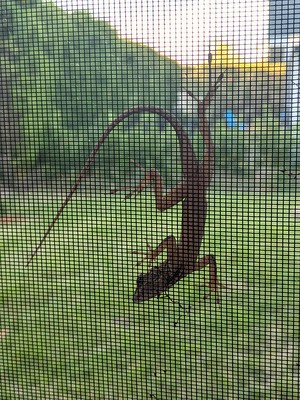
Lizard on a porch screen

Greetings,


This month I have a few science articles on freshwater, two on climate change and forest management, and one big one on biodiversity.

If you know someone who wants to sign up to receive these summaries, they can do so at http://bit.ly/sciencejon (no need to email me).

BIODIVERSITY:
Hamilton et al. 2022 is the latest analysis from NatureServe on biodiversity in the U.S., and potential priorities for new protection. They looked at habitat for 2,216 imperiled species (G1 or G2 globally, or Threatened or Endangered nationally) across the U.S., including often overlooked species like plants and bugs. There are several interesting methodological advances here (relatively fine 1-km pixels, inclusion of overlooked species, using both range maps and habitat suitability models and showing how that changes results in Fig 4, etc.), but I think most readers will want to focus on implications for new protections and management of existing protected areas. Fig 2 shows the most important areas to protect. They use protection-weighted range-size rarity, which is a kind of rarity-weighted richness focusing on places with a) relatively high # of species that b) have relatively little habitat left nationally. Table 2 has a nice summary of how many species have the majority of their habitat managed by different groups (federal agencies, state & local, private), showing there is a lot of potential for management on existing public lands (since 43% of imperiled species have most of their habitat on public lands). It's worth reading the whole thing, but if short on time I recommend the NY Times article about this and especially the interactive maps of their data.


CLIMATE CHANGE / FOREST MANAGEMENT:
Littlefield and D'Amato 2022 looks at trade-offs between maximizing forest carbon and maximizing biodiversity and habitat quality. In particular, they note that many species require disturbance (like fire or tree removal), while maximizing carbon generally involves promoting uniformly dense and mature trees. They note that robust data looking at how different species respond to forest management are surprisingly scarce, but offer several case studies where as tree biomass increased, wildlife abundance and/or diversity has declined. They recommend that conservation planning consider climate adaptation, which means keeping landscape diversity, complexity, and connectivity (accepting that means some reduction in potential carbon), and that we explicitly discuss and recognize trade-offs where they exist.

Stephenson et al. 2014 is a global analysis of how carbon sequestration by 403 tree species change as they grow and age. 87% of tree species sequester more annual carbon per year as they get bigger (even when they get huge). On average a 1m diameter tree sequesters about triple the carbon as a 1/2m diameter tree (similar to the trunk cross-section ration of 4:1). The biggest trees can add ~0.55-0.72 t biomass (not C, which would be much lower) per year (Fig 3). However, they note that at the forest level, as an even-aged stand gets older the annual carbon sequestered per land area goes down (as trees die, total sequestration declines despite remaining big trees sequestering more. Ideally forest management should think about 1) impacts on carbon pools (how much harvested tree biomass will be lost to the atmosphere), 2) impacts on carbon sequestration, and 3) impacts on forest ecology (both mature / older trees, and disturbances and younger trees have important roles).


FRESHWATER:
Broadley et al. 2022 is a global assessment (although w/ ~1/4 of studies coming from the US) of how marine fishery productivity (including invertebrates) depends on rivers. Their headline finding is that 72% of 276 fished species (77% of global catch by mass) are linked to river flows at some point in their life cycle, and 83% eat food linked to river flows. The biggest link is occasionally going to estuaries to eat (77% of species) as opposed to diadromous or estuarine-dependent species (23% of species), see Fig 5 for a map of where they're distributed. They also offer a conceptual review of how rivers influence fisheries by focusing on science literature for the top 10 fishery species by catch mass. They conclude that rivers influence fisheries via physical changes (flow quantity, timing, and quality [sediment, nutrients, salinity, temperature, etc.]), biological response of marine species to those physical changes (e.g. nutrients from a river increasing algae which zooplankton and fish respond to, changes in spawning in response to freshwater mixing, migration, etc.), and changes in fisher behavior and fishery productivity resulting from those biological changes (see Table 1). They recommend an integrated planning approach to rivers (including dam management) and marine fisheries.

Pennock et al. 2022 makes a case that rivers with relatively natural flow regimes should be priorities for conservation (specifically protection that limits consumptive water use or otherwise alters flow). They look at four tributaties of the Green River (which feeds the Colorado River): the White, Price, San Rafael, and Duchesne Rivers. Only the White River has a relatively natural flow regime (although median spring discharge is still down 25% relative to before 1949, and summer baseflow by 29%), and spring flow in the Duchesne and San Rafel are down ~80%. That drop in flow accompanies habitat degraded in several ways: less large woody debris, narrower channels, less regeneration of cottonwoods, loss of native fish spp, etc. They also point out that even dams managed for environmental flow has fallen well short of natural flood regimes.

Maasri et al. 2022 is a new global freshwater research agenda. They have 15 recommendations in 5 themes: 1) Data infrastructure (compile and integrate data sources on freshwater biodiversity, mobilize and share existing data w/ stakeholders, and develop accessible databases), 2) Monitoring (coordinate existing FW biodiversity monitoring and move towards global consistency, expand monitoring to places and species currently overlooked [like fungi and protists], and develop new monitoring methods [like eDNA, remote sensing, citizen science, etc.]), 3) Ecology (better understand how biodiversity relates to ecosystem health and services, study how biodiversity responds to multiple stressors, and study species and ecosystem responses to global change), 4) Management (rigorous assess how well restoration works, develop management strategies aligned with "Nature Futures" scenarios based on positive human-nature relationships, and develop watershed-based integrated management and restoration programs including dam building and operation), and 5 Social ecology (co-produce solutions to conflicts between conservation and people who use freshwater systems, develop adaptive management strategies that address trade-offs with a broad coalition of participants, and promote citizen science and participatory research). I was surprised that they left off legal research into how policy mechanisms for water management are working (or not), and am somewhat skeptical that agendas like this get used, but it's a nice overview of some needs and gaps.


REFERENCES:

Broadley, A., Stewart-Koster, B., Burford, M. A., & Brown, C. J. (2022). A global review of the critical link between river flows and productivity in marine fisheries. Reviews in Fish Biology and Fisheries, 0123456789. https://doi.org/10.1007/s11160-022-09711-0

Hamilton, H., Smyth, R. L., Young, B. E., Howard, T. G., Tracey, C., Breyer, S., Cameron, D. R., Chazal, A., Conley, A. K., Frye, C., & Schloss, C. (2022). Increasing taxonomic diversity and spatial resolution clarifies opportunities for protecting US imperiled species. Ecological Applications, 32(3), 1–19. https://doi.org/10.1002/eap.2534

Littlefield, C. E., & D’Amato, A. W. (2022). Identifying trade‐offs and opportunities for forest carbon and wildlife using a climate change adaptation lens. Conservation Science and Practice, 4(4), 1–14. https://doi.org/10.1111/csp2.12631

Maasri, A., Jähnig, S. C., Adamescu, M. C., Adrian, R., Baigun, C., Baird, D. J., Batista‐Morales, A., Bonada, N., Brown, L. E., Cai, Q., Campos‐Silva, J. V., Clausnitzer, V., Contreras‐MacBeath, T., Cooke, S. J., Datry, T., Delacámara, G., De Meester, L., Dijkstra, K. B., Do, V. T., … Worischka, S. (2022). A global agenda for advancing freshwater biodiversity research. Ecology Letters, 25(2), 255–263. https://doi.org/10.1111/ele.13931

Pennock, C. A., Budy, P., Macfarlane, W. W., Breen, M. J., Jimenez, J., & Schmidt, J. C. (2022). Native Fish Need A Natural Flow Regime. Fisheries, 47(3), 118–123. https://doi.org/10.1002/fsh.10703

Stephenson, N. L., Das, A. J., Condit, R., Russo, S. E., Baker, P. J., Beckman, N. G., Coomes, D. A., Lines, E. R., Morris, W. K., Rüger, N., Álvarez, E., Blundo, C., Bunyavejchewin, S., Chuyong, G., Davies, S. J., Duque, Á., Ewango, C. N., Flores, O., Franklin, J. F., … Zavala, M. A. (2014). Rate of tree carbon accumulation increases continuously with tree size. Nature, 507(7490), 90–93. https://doi.org/10.1038/nature12914


Sincerely,
 
Jon

Thursday, August 1, 2019

August 2019 science journal article summary


Photo from Mick Garratt

Greetings,

Hot weather and a vacation in the woods have me thinking about climate change and habitat conversion (with articles on deforestation, landscape conservation, biodiversity, and livestock sustainability).

If you know someone who wants to sign up to receive these summaries, they can do so at http://bit.ly/sciencejon

LANDSCAPE CONSERVATION:
Runting et al. 2019 argues that debates about 'land sparing' vs 'land sharing' miss an important point - good forest management is likely more important. They run several scenarios with different degrees of land sharing vs sparing, and conventional vs. improved management (reduced-impact logging, longer plantation rotation, and strictly enforcing protected areas). They saw the best outcomes with improved management and a mix of sparing and sharing (but favoring sparing, see Figure 4). Check out Figure 2 for what an 'optimal' scenario looks like compared to extreme sharing or sparing (but ignore the idea that tiny islands of protected areas or holes in larger ones are ideal - this is almost certainly an artifact). There's a blog on this one at https://nature4climate.org/news/headline-stories/cant-see-the-wood-for-the-trees-making-the-most-of-our-forests-for-biodiversity-and-wood-production/

Kennedy et al. 2019 calculates how modified by human activities land around the world is. While only 5% of land area was 'unmodified', most of the world was 'moderately modified.' The authors argue that ecoregions with moderate modification may be good candidates for high priority conservation action, because they tend to have some relatively intact lands near to highly modified lands (which thus may pose a threat in the near future). In particular, the tropical and subtropical dry broadleaf forests biome (mostly in Mexico, India, Argentina, & SE Asia) was found to be the most threatened (high conversion relative to protection). While they didn't include all threats (e.g. logging, invasive species, climate change, and more) these data can be used to evaluate the suitability of lands for protection. You can explore the findings and maps at http://gdra-tnc.org/current/ and you can download the data from http://s3.amazonaws.com/DevByDesign-Web/Apps/gHM/index.html


CLIMATE CHANGE:
Bastin et al. 2019 estimate 900 million ha of land could be reforested globally (excluding cropland and urban areas), which could store 205 Gt of carbon (752 Gt CO2e). Alternatively, they predict we'll lose 223 million ha of forest by 2050 under business as usual. This paper has been broadly criticized for overstating the role of reforestation in climate mitigation (while reforestation is important, the authors' conclusion that it's the most important solution is a fringe opinion), especially since they call for a focus on boreal plantings which reduces albedo relative to bare snow and ice (thus reducing the climate mitigation contribution). Here's a blog covering the paper including the critique: http://blogs.discovermagazine.com/crux/2019/07/10/reforestation-climate-change-plant-trees/#.XSdzAehJE2w

Diaz et al. 2018 looks at trade-offs between different forest management options for Douglas-fir in the NW US that could improve carbon storage. They compare managing the land to optimize net present value (NPV) to managing for sustained timber yield (with different levels of environmental management, e.g. longer rotations and some aspects of FSC certification). They find that environmental constraints boost carbon storage but hurt net present value. For example, one scenario had 26% more carbon, but 15% less timber and 21% lower NPV. They explore different policy options and challenges related to driving more carbon storage in timberlands.


DEFORESTATION:
Lambin et al. 2018 look at how effective company commitments to end deforestation are. The key finding is that public policy can significantly improve the likelihood of reducing deforestation relative to private action alone. For example, the Soy Moratorium combined sector-wide commitments with monitoring and public disincentives to clear forest in Brazil, with some success. They call for better company commitments (as called for by the Accountability Framework, https://accountability-framework.org/), and recommend public policies including: legal reform & enforcement, land tenure reform, working with people clearing the most forest, broadening scope (companies, commodities, & regions), incentivizing all actors in the supply chain to participate (e.g. fertilizer companies rarely engage in these commitments), improving traceability and transparency, and increasing demand for deforestation-free products.


LIVESTOCK SUSTAINABILITY:
Schader et al. 2015 looks at how shifting what we feed cattle could improve sustainability. The idea is to feed them less food humans could eat (like corn), and more grass and by-products we can't or don't eat (e.g. distiller's grains, bran, oilseed cake, etc.), which also limits the total amount of livestock which can be raised in this way. Figure 1 is a great overview of what this would mean, for example a big reduction in pigs and chicken and only modest increases in other livestock (that can eat grass). But note a cardinal data visualization sin: inconsistent scaling of bar charts (e.g. the soil erosion from water chart makes it look like their preferred scenario has only 42% the erosion of the reference scenario, but it actually has 88% the erosion) which means you have to look carefully. Still, it's an important concept to explore, and a useful contribution to the conversation.

What are the barriers to using livestock practices that reduce GHGs? Kipling et al. 2019 asked Welsh ranchers and other stakeholders in a series of interviews and workshops. They focused on the conceptual framework rather than the practices, splitting them into practical limitations (e.g. costs and infrastructure, see Figure 1), knowledge limitations (being unaware of options and how they work, see Figure 2), and cognitive limitations and interests (complexity and competing values, see Figures 3 & 4). There aren't any big surprises here, but it's a useful overview, especially the quotes from ranchers for each concept they present.


BIODIVERSITY:
Humphreys et al. 2019 looks at recent (since 1900) and historic plant extinction, and compares it to animal extinctions. The most interesting findings are that the IUCN Red List data on extinct plants are pretty poor (with 50 Red List species incorrectly listed as extinct, and 491 extinct species missing from the Red List), that 54% of plants reported extinct were later rediscovered (or reclassified to be the same as an extant species), that thousands of extant plant species are 'functionally extinct' (too few exist to form a viable population going forward), and that 55% of the 571 plant species that have gone extinct have done so since 1900. This is a short paper and worth reading.

REFERENCES:
Bastin, J.-F., Finegold, Y., Garcia, C., Mollicone, D., Rezende, M., Routh, D., … Crowther, T. W. (2019). The global tree restoration potential. Science, 365(6448), 76–79. https://doi.org/10.1126/science.aax0848

Diaz, D. D., Loreno, S., Ettl, G. J., & Davies, B. (2018). Tradeoffs in timber, carbon, and cash flow under alternative management systems for Douglas-Fir in the Pacific Northwest. Forests, 9(8), 1–25. https://doi.org/10.3390/f9080447

Humphreys, A. M., Govaerts, R., Ficinski, S. Z., Nic Lughadha, E., & Vorontsova, M. S. (2019). Global dataset shows geography and life form predict modern plant extinction and rediscovery. Nature Ecology & Evolution, 3(July). https://doi.org/10.1038/s41559-019-0906-2

Kennedy, C. M., Oakleaf, J. R., Theobald, D. M., Baruch-Mordo, S., & Kiesecker, J. (2019). Managing the Middle: A Shift in Conservation Priorities based on the Global Human Modification Gradient. Global Change Biology, (June 2018), 1–17. https://doi.org/10.1111/gcb.14549

Kipling, R. P., Taft, H. E., Chadwick, D. R., Styles, D., & Moorby, J. (2019). Challenges to implementing greenhouse gas mitigation measures in livestock agriculture: A conceptual framework for policymakers. Environmental Science and Policy, 92(November 2018), 107–115. https://doi.org/10.1016/j.envsci.2018.11.013

Lambin, F., Gibbs, H. K., Heilmayr, R., Carlson, K. M., Fleck, L., Garret, R., … Walker, N. (2017). The role of supply-chain initiatives in reducing deforestation. Nature Climate Change, 8(February), 109–116. https://doi.org/10.1038/s41558-017-0061-1

Runting, R. K., Ruslandi, Griscom, B. W., Struebig, M. J., Satar, M., Meijaard, E., … Venter, O. (2019). Larger gains from improved management over sparing–sharing for tropical forests. Nature Sustainability, 2(1), 53–61. https://doi.org/10.1038/s41893-018-0203-0

Schader, C., Muller, A., El-Hage Scialabba, N., Hecht, J., Isensee, A., Erb, K. H., … Niggli, U. (2015). Impacts of feeding less food-competing feedstuffs to livestock on global food system sustainability. Journal of the Royal Society Interface, 12(113). https://doi.org/10.1098/rsif.2015.0891


Sincerely,

Jon

p.s. If you'd like to keep track of what I write as well as what I read, I always link to both my informal blog posts and my formal publications (plus these summaries) at http://sciencejon.blogspot.com/