Friday, September 28, 2012

The quickest, easiest way to save water

My latest blog post is essentially an analysis showing that you could shut off your water at home (no toilet, no shower, no washing machine, etc.) and still have less impact than switching from beef to soy once per week. Here's the full article: http://bit.ly/TMjfg6

If you don't like soy you can still have a big impact by switching to other types of beans / lentils / legumes, and an even bigger impact by switching to grains (just be aware that nuts actually have a pretty high water footprint). If you want to look up the water footprint of specific foods, you can browse through a few of them at http://www.waterfootprint.org/?page=files/productgallery, and see a comprehensive list at http://www.waterfootprint.org/Reports/Mekonnen-Hoekstra-2011-WaterFootprintCrops.pdf


For people who don't eat burgers: any 1/3# serving of beef (steak, roast, etc) you swap out for a 1/3# soy burger still saves you about 579 gallons each time. Eating the soy burger instead of a 1/3# serving of pork saves 196 gallons (almost 3 days of home water use), and the soy burger saves 130 gallons over 1/3# serving of chicken (over two days of home water use). If you drink milk, every half gallon of soy milk you buy instead of cow's milk saves 377 gallons of water, which works out to a savings of 47 gallons of water per cup of soy milk. Coconut or oat milk also have low water footprints, but almond milk has a water footprint almost as high as cow's milk.

People interested in the water footprint (how much total water something takes to produce) of various animal products and some plant alternatives should check out http://www.waterfootprint.org/?page=files/Animal-products

It was pointed out to me (in a comment on http://blog.nature.org/2012/10/the-quickest-easiest-way-to-save-water/) that the water use for beef I cited is a global average, and that in the US our beef has a lower water footprint. There is another paper calculating water footprint of livestock by nation (http://www.waterfootprint.org/Reports/Report-48-WaterFootprint-AnimalProducts-Vol1.pdf), and they found that the water footprint for a 150g beef burger in the USA would be 562 gallons rather than 621 . That translates to a savings of 520 gallons of water for each soy burger consumed instead of an American beef burger. That still works out so that eating a soy burger instead of an American beef burger once per week saves more water than the average total indoor water use for a week.

Also, hopefully this goes without saying for people who know me, but unlike some similar figures you may have heard (usually from vegetarian advocacy organizations) this one is based on some really solid science and calculations. While one can debate the methodology used, the water footprint numbers have been validated by other authors (Zimmer & Renault 2003, Oki et al 2003). If you want to check or replicate my work you can download the spreadsheet where I made my calculations (which includes the citations) from http://fish.freeshell.org/green/WaterFootprint.xlsx


Water Footprint / Water Paw

Tuesday, September 18, 2012

Nature's Copycats: Biomimicry in Action

A shorter version of this article appeared on The Nature Conservancy's Cool Green Science blog (http://blog.nature.org/conservancy/2012/08/30/natures-copycats-butterflies-hornets-and-orangutans/), but I didn't want to deprive people of the opportunity to learn about mantis shrimp as well. Here's the original full length article:

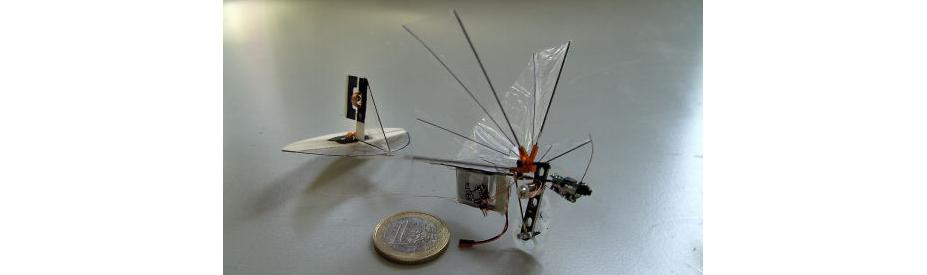
When I was in elementary school, I learned that it was “aerodynamically impossible” for bumblebees to fly. Even at that age, it was a clue that humans still have a lot to learn from nature! As it turns out, bees (and other insects) fly more like helicopters than like birds or fixed-wing airplanes, and studying how they fly has led to innovations in the design of tiny autonomous flying robots (useful for surveillance, search and rescue, playing the James Bond theme, etc.). Similarly, the unique way that hummingbirds fly (combining elements of insect and bird flight) is providing clues to building flying machines that can better handle windy conditions.
DelFly Micro, a small camera-carrying ornithopter,” Copyright Delft University of Technology (www.DelFly.nl)

Copying nature isn’t a uniquely human pursuit; plants and animals have been doing it for a very long time. For example, both Monarch & Viceroy butterflies have a very similar appearance (despite belonging to different genera), and both contain toxins that make them an unpleasant meal. As these two species evolved towards a common appearance, they benefited from an increased chance that a predator had already learned to avoid orange and black striped butterflies after suffering from a bitter taste and an upset stomach. In this case, both species benefit by looking the same (which scientists call “Müllerian” mimicry) as they both get eaten less.
Monarch Butterfly Viceroy Butterfly

Left image: “Monarch Butterfly”, flickr user steveburt1947. Right image: “Viceroy Butterfly”, flickr user steveburt1947

But of course, not all mimics help each other out. In some cases, just as you’ve built up a tough reputation by spending a lot of energy developing natural defenses, some punk copycat shows up looking for a free ride. For example, many bees, wasps, and hornets share a pattern of alternating yellow and black stripes (another example of Müllerian mimicry). But since so many predators have learned to avoid them, they are also a popular target of “Batesian” (or freeloading) mimics. From moths to flies to beetles, many harmless insects have found that as long as their population size is low relative to their more dangerous lookalikes, predators will play it safe and avoid them too.
Drone Fly Hornet Moth
Left image: “Drone Fly,” flickr user joysaphine. Right image: “Hornet Moth”, flickr user averribi.

While bees and wasps may be the insect “cool kids” other insects want to imitate, an even tougher creature is getting a lot of attention from human would-be mimics lately: the mantis shrimp. This beautiful, terrifying creature is probably best known for its ability to punch with almost the force of a 22 caliber bullet (and has been known to break aquarium glass). But recently, researchers realized that more exciting than the power of their strike is the fact that their arm can withstand thousands of high-velocity strikes before being replaced by molting. That could lead to lighter body armor or even more efficient cars. In addition to being the champion boxers of the crustacean world, mantis shrimp also have the most complex eyes in the animal kingdom. They have 12 different photopigments to see color (as opposed to the paltry three of humans), can see infrared and ultraviolet light, and can distinguish between different forms of polarized light. The part of their eyes that deals with polarized light outperforms synthetic equivalents that are used in CD and DVD players, camera filters, and even 3-D movies and holograms. Even Superman might want to imitate this amazing creature!

Video Thumbnail: “Mantis Shrimp,” flickr user pacificklaus.

But before we congratulate ourselves for our cleverness in imitating nature, perhaps we should be worrying about one more type of biomimicry: animals imitating us. From simple examples like sparrows learning to open automatic doors to get into a bus station café to impressively complex ones (see the video below of an orangutan stealing a canoe, paddling out to a boat, stealing a fish trap, and eating the fish), it might not be long before the idea of dogs playing poker doesn’t seem funny anymore. Now that we know that crows can not only recognize our faces but describe us to other crows, we might want to step up our game before they figure out the best way to put us to work for them. Be sure to check out Biomimicry News to keep track of our progress!
 

Sunday, September 16, 2012

Is compostable "plastic" (PLA) really compostable?

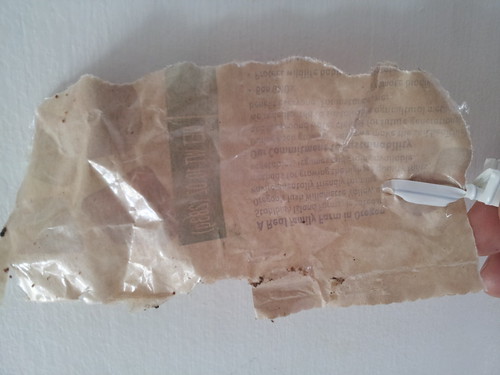
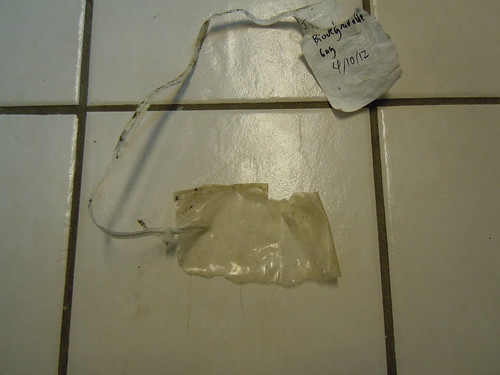
Earlier I wrote a post about how "green" compostable containers are, and found that most compostable containers can't actually be composted at home. However, when I got a bag of frozen rhubarb that said it was compostable, I decided to try it for myself. I was hoping that since the bag was so thin it might break down more easily than a thicker cup or something. Not so. Here's what it looked like before being composted (for 4.5 months in a home worm bin):

Here's what it looked like after being composted. Note that while the paper backing degraded, the "plastic" part didn't break down at all as far as I could tell. The strength of the material was unchanged:

Some people I've met claim that with a sufficiently large / hot compost pile at home, this material can indeed be broken down, or that it will break down eventually. I'm putting it back into the bin for another pass through just in case, and I'll report back in several more months!

Thursday, August 16, 2012

Data as Sand: Why Data Management is Relevant to Conservation

For a team meeting a while back, we were asked to record videos that explain what we do. Using grains of sand as a metaphor for pieces of digital information, I walk through how much "sand" we have in the world, and how my work helps people get relevant conservation information.

How Flying Undermines Your Green Lifestyle

How is it possible that a vegan, car-free, green living fanatic can have a bigger carbon footprint than the average American?  The original blog where I answered that question (on care2.com) expired after 5 years, so I've replicated the first half of it here using the always amazing Wayback Machine - the second half is lost to the ages.


How is it possible that a vegan, car-free, green living fanatic (that’s me) has a bigger carbon footprint than the average American? It’s pretty simple: for people who travel a lot—whether for work, pleasure or both—flying can outweigh everything else we do to live green.
Like many eco-minded people, sometimes I’m a bit self-righteous about green living and I get frustrated when friends and family seem to not “get it.” But recently I’ve been trying to objectively look at my overall environmental impact, and I’ve realized that some of the things I obsess over make less of a difference than the things I have given myself a “free pass” to do in the past—especially travel.
For example, a few years ago I attended a conference in Borneo (Indonesia) for work, learning about The Nature Conservancy’s projects there and conducting a few days of technical training for local staff. When I calculated the emissions for the flights for that trip, it had a total carbon footprint of 11.7 metric tons of CO2 equivalent(1), more than the total household energy use (electricity, gas, etc.) of the average American family for a whole year!(2) While I am hopeful that the purpose of the trip was worth the emissions, it’s still a pretty scary number.
Which led me to a disturbing realization: all of my efforts to shrink my carbon footprint—from eating vegan/organic/local foods to installing energy-efficient appliances in my home and commuting by bike—are quickly “wasted” if I fly often. Simply staying close to home can have a bigger impact than all those activities, at least in terms of carbon footprint.


Let’s take a look at this chart(3) comparing the carbon emissions of flight travel to various “green” activities to illustrate my point:

(more text)
Sources / footnotes:
1 Calculations of carbon footprint from http://carbonfund.org/offset/individuals . I used the actual flight pattern which included three layovers; a direct flight from DC to Balikpapan would have been slightly less (9.5 metric tons CO2E). Note that CO2E (or CO2 equivalent) indicates that factors including radiative forcing and other greenhouse gases like methane have been accounted for so that their actual impact is measured in how much pure CO¬2 would be emitted to have the same impact. For long distances, flying is typically more efficient than one person driving the same distance, but for simplicity only flight emissions are calculated here.
2 See the "home energy use" section on http://www.epa.gov/cleanenergy/energy‐resources/refs.html.
3 Chart calculations: As noted above, http://carbonfund.org/offset/individuals was used to calculate the CO2E, using actual flight patterns I have taken (including layovers where the cheapest flight from DC uses them), and including radiative forcing. The impact of switching from the average American diet to a vegan one (or from a "red meat" diet to the average one) was calculated in http://pge.uchicago.edu/workshop/documents/martin1.pdf. The average American diet gets 28% of calories from animal sources, of which 54% comes from meat (roughly 60% red meat and 40% chicken and fish). The "red meat" diet assumes 50% of calories from animal sources, all of which is red meat. The efficiency of the Camry (28 mpg combined, http://www.fueleconomy.gov/feg/bymodel/2012_Toyota_Camry.shtml) and Prius (50 mpg combined, http://www.fueleconomy.gov/feg/bymodel/2012_Toyota_Prius.shtml) were plugged into the vehicle emissions equation on http://www.epa.gov/cleanenergy/energy‐resources/refs.html to generate the projected annual emissions of each vehicle. The emissions savings from insulation and sealing drafts came from the EPA's estimate that homeowners can save up to 10% on total energy costs through such activities (http://www.energystar.gov/index.cfm?c=home_sealing.hm_improvement_methodology) combined with the EPA's estimates of average annual home energy use (see citation #2); the actual impact will vary substantially by home/region but I didn’t have data on the range of values in the U.S. The range of emissions savings from replacing single pane with energy star windows (shown as minimum and maximum values) came from http://www.energystar.gov/index.cfm?c=windows_doors.pr_benefits. Note that for windows a range of emissions is presented as it varies by region, and that if replacing double‐pane windows the savings are much lower. The emissions savings from recycling used the figures from http://www.popularmechanics.com/science/environment/recycling/4291576 to calculate the total amount of CO2 emissions avoided by recycling aluminum, glass, newsprint, and #1 plastics in the U.S. (other less commonly recycled materials were not considered). That figure was then divided by the 2010 population of the U.S. to get the average amount of CO2 emissions avoided by recycling per American.
4 How much water can you save by cutting back on animal products? Replacing a single hamburger with a soy burger saves 579 gallons (http://pge.uchicago.edu/workshop/documents/martin1.pdf), which has about the impact of using no water at home (not counting food/fiber, but including everything else) for over 8 days (based on daily usage from http://www.drinktap.org/consumerdnn/Home/WaterInformation/Conservation/WaterUseStatistics/tabid/85/Default.aspx)! Replacing a half gallon of cow's milk with soy milk saves 398 gallons or almost 6 days of water (555 gallons H20 per ½ gallon cow's milk vs 157 gallons H20 per ½ gallon soy milk).
5 See the "passenger vehicle" section of http://www.epa.gov/cleanenergy/energy‐resources/refs.html for the basic equation used to calculate emissions.

Tips for More Eco-Friendly Clothing

Not sure whether bamboo or organic cotton is better for the environment? Confused by all the competing claims about "green" clothing? I sure was before researching and writing this piece.
http://bit.ly/Ns2GDe

Tips to Make Your Office More Bike-friendly

Want to green your office by making it easier to bike to work? Here are a few tips to get started:
http://bit.ly/R4yMo6
Green commuting kiosk at The Nature Conservancy's Worldwide Office