Tuesday, March 28, 2017

Monthly Journal Article Summaries (coming soon)

For the last several years, I've sent monthly summaries of the journal articles I've read that I found useful enough to be worth passing on to a handful of colleagues. I've been reluctant to make those public to avoid having to worry about whether I'm being diplomatic / fair enough in characterizing them, but I've decided to just go for it. Let me know if you have any thoughts or reactions in the comments.

I usually send these out around the first of each month, but here's one from last year that includes one of my favorite papers of 2016:

Social Science:
If you ever play a role in hiring new staff, please read this article (if not the paper it's based on, Kang et al 2016), and even if you never hire people, I'd still encourage you to read it:
I guarantee you will find it fascinating, and hopefully useful as well (the full paper is also a page-turner; well written, a great experimental design, and full of surprises to me as a white male). Essentially the authors found that statements by employers encouraging diversity in applicants to a job harms minorities. The reason is that some minorities "whiten" their resume to make it less apparant that they are a minority, which in turn increases their chances of proceeding to an interview (e.g. they found a fictious black candidate was 2.5 times as likely to be invited to proceed to an actual interview if they whitened both their name and experience than if they applied with an unwhitened resume). Statements encouraging diversity led applicants to not whiten their resumes, but by encouraging them not to hide their identity, less minorities get hired. It's kind of a complex 3-part study but it's really clear if you put in the time to read it. The lead author helpfully sent me several suggestions of what we can do to improve in hiring, from blind initial screenings (removing names to reduce cues about gender and ethnicity), to education on unconscious bias, and many more. I've put these below as a p.s.

Kowalski and Jenkins 2015 is a nice paper emphasizing that having a clearly defined leadership structure is more important to make collaborative groups function well than having good connections between all of the members. In other words, having someone to coordinate and make it clear what everyone's role is was found to be more important than a more egalitarian (but unclear) setup. However, this paper is based on a very small sample so I wouldn't consider it definitive.


Agriculture:
Kniss et al 2016 is a nice overview of some of the trade-offs between organic and conventional agriculture. They find a consistent 20% yield gap for organic, but argue since that higher yields only lead to less farmland area (and presumably more habitat) in certain circumstances, this may be worthwhile given the other benefits. You can read a summary of the paper here:

Baur et al 2016 is the latest from TNC California and their partners about specialty crop farmers (fruits, vegetables, and nuts) that are being pushed to clear habitat around their farms (due to concerns about E Coli which have been proved to be unfounded). In addition to summarizing the earlier findings from this research, they conducted a detailed survey showing how much variation there is in implementing food safety practices, as well as perceptions of farmers about those practices. Pressure from auditors and food buyers may be responsible; they call for clearer guidelines that allow for some flexibility in improving food safety.

Ryals et al 2016 found that a single application of compost (which breaks down more slowly than inorganic fertilizer) to rangelands boosted grassland productivity (more food for cattle), grass N content (more nutritious grass), and didn't impact invasive species. However, one of their two sites showed a decline in native species and the other showed mixed results on natives. Sometimes fertilization is proposed as a way to increase carbon sequestration, although it has to be done carefully to avoid nitrous oxide emissions from the fertilizer and from manure which can counteract the gains in C (and this paper doesn't account for that).

Baidoo et al 2016 is not very well written or clear, but it does show that botanical insecticides (garlic and hot pepper) are viable forms of pest control for cabbage. Essentially while they did not kill as many pests as a synthetic insecticide, they also were much lower cost, didn't kill as many natural enemies of the pests, and were less persistent in the environment. The authors actually found a better benefit:cost ratio for the botanical controls than the synthetic one, even without price premiums for organic pest control.

Jon

p.s. Here are the suggestions from Dr. Kang about how to improve diversity when hiring:
"Initial blind screening (replacing names from resumes and letters with random IDs) is an excellent way to start. Another great step is to start educating people about unconscious bias. Making people aware of these biases and how they might affect the hiring process is a critical step.


Other things you can try are diversifying the search committee, emphasizing the goal of a fair process (people sometimes get defensive about diversity because they think that it antithetical to a search for excellence - reassure people that excellent people will still rise to the top in a fair search), spend sufficient time and attention evaluating everyone on the short list/those that come in for an interview (we are more likely to fall back on stereotypes and prejudices when we are under time pressure), base decisions on concrete information in the application package (this means that discussions of fit have to be grounded in the application not based on peripheral concerns), create very clear criteria for evaluation and don't discuss anything outside of this list, and make sure any criteria/question applied to one candidate is applied to every candidate."

References:

Kang SK, DeCelles KA, Tilcsik A, Jun S. Whitened resumes: Race and self-presentation in the labor market. Adm Sci Q. 2016; doi:10.1177/0001839216639577

Kowalski AA, Jenkins LD. The role of bridging organizations in environmental management : examining social networks in working groups. Ecol Soc. 2015;20: 16. doi:10.5751/ES-07541-200216

Kniss AR, Savage SD, Jabbour R. Commercial Crop Yields Reveal Strengths and Weaknesses for Organic Agriculture in the United States. 2016; 1–16. doi:10.1371/journal.pone.0161673

Baur P, Driscoll L, Gennet S, Karp DS. Inconsistent food safety pressures complicate environmental conservation for California produce growers. Calif Agric. 2016;70: 142–151. Available: http://calag.ucanr.edu/archive/?article=ca.2016a0006

Ryals R, Eviner VT, Suding KN, Silver WL. Grassland compost amendments increase plant production without changing plant communities production without changing plant communities. Ecosphere. 2016;7. doi:10.1002/ecs2.1270

Baidoo PK, Mochiah MB. Comparing the Effectiveness of Garlic (Allium sativum L.) and Hot Pepper (Capsicum frutescens L.) in the Management of the Major Pests of Cabbage Brassica oleracea (L.). Sustain Agric Res. 2016;5: 83. doi:10.5539/sar.v5n2p83

Wednesday, November 9, 2016

reThink Soil: A Roadmap to U.S. Soil Health

We just released a new report on the potential benefits of adoption soil health practices in the U.S., and the conclusions are pretty exciting! You can read a brief overview, the executive summary, and the full paper at http://nature.org/soil. Much of the analysis was done by consultants we worked with, but I provided lots of scientific guidance and review throughout the process.


The web page has a good summary of some of the key points, but to put it even more succinctly, we argue that the adoption of three soil health practices (no-till, cover crops, and crop rotations) on U.S. row crops could have massive benefits both to society (e.g. improved water quality, reduced GHGs) and to the farmers implementing them (reduced soil erosion, improved soil quality and resilience).

For instance, if half of the farmland used to grow corn, soy, and wheat were to adopt all three practices, it could generate $7.4 billion in total benefits, and if all the farmland for those three crops adopted them it could be $19.6 billion (note that it's not double because some farms already use some of these practices). If you take the more optimistic upper range of our estimates, total societal benefit for 100% adoption of all three practices could be $49.8 billion. A lot of the science is uncertain, so these estimates are rough but we drew on the best available data to come up with them, and we are confident that the magnitude of the opportunity is valid even if the exact numbers are off.

Tuesday, November 8, 2016

U.S. Beef Supply Chain - Impacts and Opportunities

Surprisingly, there are very few assessments of the overall environmental impact of beef across the supply chain (looking at all phases of their life). The only ones we've found have a clear bias either favoring industrial systems or grass-finished systems. So, The Nature Conservancy decided to fill that gap with a rapid assessment.
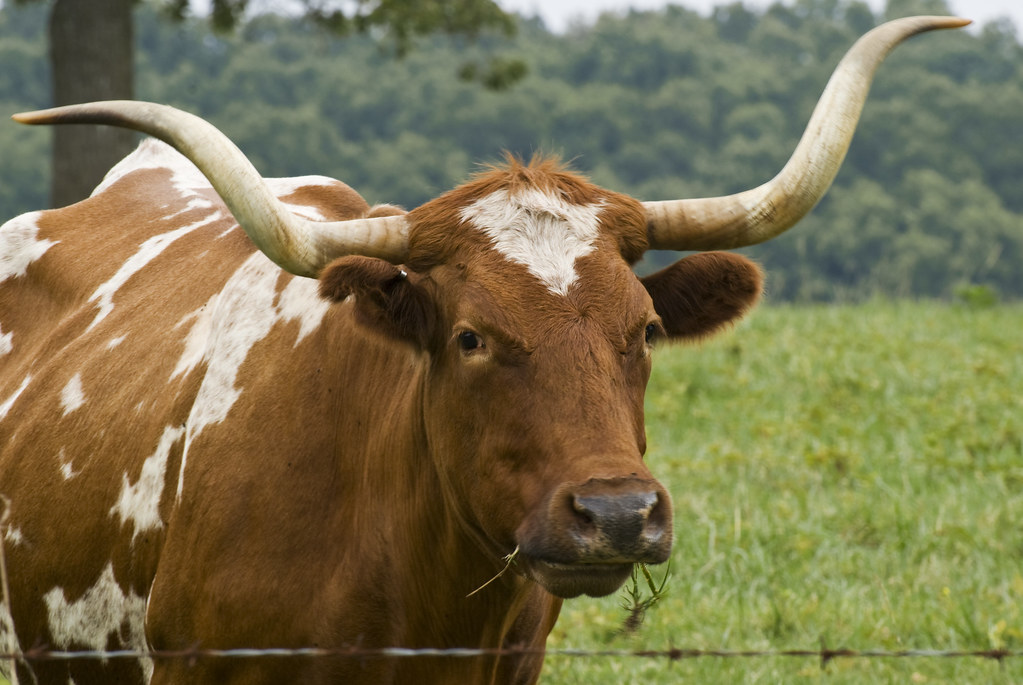
Longhorn
Longhorn in Southwest Missouri from Flickr user Jeff Weese. https://www.flickr.com/photos/jeffweese/3896957110/. Used under Creative Commons license (https://creativecommons.org/licenses/by/2.0/)
We looked at major impacts and opportunities to improve for each of the different production phases: ranch and farm grazing (cow-calf ranches, stockers, backgrounders, etc., when they're roaming about and grazing), feed production (growing hay / silage and row crops to be fed to cattle), feedlots (operation of the feedlot where they're fattened not including growing the feed), and harvest facilities (slaughterhouses).

You can read a bit about the report and our major findings here:

The report can be directly downloaded here:

The most interesting / surprising finding to me was that the grazing phase actually had the biggest impact. The key is that while it's fairly low impact per acre, it's by far both the largest footprint and where cattle spend the most time. So put together we actually see more greenhouse gas emissions, water quality impacts, and wildlife habitat impacts from that grazing phase.

A couple of key notes: Walmart provided funding for this report but had no editorial control or input into the content of the paper. Also, this was a rapid assessment (it took place over 6 months in between other work) by a small team of four scientists, so we do not have all the answers. Some critical issues we didn't have time to assess include impacts of dairy cattle, a comparison of the impact of beef to other protein sources (vegetable and animal), animal welfare and social issues, and the return on investment of different sustainability options (e.g. what would provide the most benefit per dollar spent). That's all important but was too much for us to tackle.

Finally, I occasionally have people ask me "Why should I trust you (as a vegan, or as an environmentalist) to give me accurate information about livestock and agriculture?" My answer is usually the same, which is that I encourage people not to simply trust me: instead look at the work, check my assumptions / calculations / sources, and come to your own decision about whether or not the analysis has merit. My job is to be as honest, accurate, and transparent as possible to make that process easy. Along those lines, I'm happy to take questions / critiques here.

Sunday, September 25, 2016

Sneak preview of (hopefully) upcoming publications

From August 2016 through the end of this year, I hope to have submitted 10 peer-reviewed articles / chapters for publication! In the meantime I'm hard at work writing as much as I can.
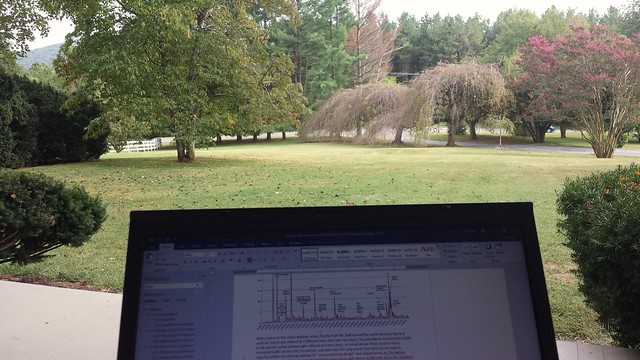
Science writing outside at briar patch b&b

They are as follows (let me know if you want any abstracts):
1. A remote sensing paper where we detected agricultural ditches and ridge-tillage, and show how important those practices are for erosion control in our study area in Kenya (submitted, second author).
UPDATE: published at http://www.tandfonline.com/doi/full/10.1080/01431161.2017.1327125
2. A book chapter for a Oxford University Press book about scientific findings that go against expectations. It's about the analysis I did for another book chapter (Cambridge University Press, not published yet) which I reported on here: http://blog.nature.org/science/2014/06/18/global-agriculture-land-sustainability-deforestation-foodsecurity/ (Reviewed / Accepted, sole author).
UPDATE: publishedhttps://global.oup.com/academic/product/effective-conservation-science-9780198808985?cc=se&lang=en& and an ugly unformatted version is available at http://fish.freeshell.org/publications/DataNotDogma-Chapter11-preformatted.pdf

3. A paper outlining how we tied traditional detailed household surveys to spatial data by having farmers outline their actual plots on tablets with high resolution imagery (should be submitted in a few weeks, second author)
UPDATE: Has been submitted and rejected twice, both times after a 4-month review with only one reviewer. Submitted a third time.

4. A paper that was part of a water fund project in Brazil; a water treatment company is going to pay for conservation to reduce the costs of treating the water. So the paper asks how much of a difference it makes if we use high resolution data (expensive and time consuming) vs low resolution (free and faster) on our water quality estimates (hopefully submitted in a month or two, first author). UPDATEpublished at http://onlinelibrary.wiley.com/doi/10.1002/rse2.61/full

5.-8. There is a series of four papers on knowledge diffusion (spread and uptake of new ideas); I'm leading one and I believe I'll be on the other three as an author since we've been working together on the research as a team for 2 years. The one I'm leading uses a rich array of data to examine both internal and external diffusion at The Nature Conservancy (TNC) from a few different angles, one uses an experiment to show how "boundary spanners" (people with social networks that connect to a variety of other groups) play a critical role in spreading knowledge, one looks at how people actually change what they do in response to new methods becoming available, and one compares two groups within TNC and examines how their response to and alignment with the new methods differs. Read more about the overall project here: http://blog.nature.org/science/2015/07/29/tracking-how-new-science-spreads/ (will all be submitted by end of October, one as first author and the rest as a minor author)
UPDATE: 1 published (http://journals.plos.org/plosone/article?id=10.1371/journal.pone.0193716), 1 accepted, 1 submitted, 1 more being revised for resubmission

9. We are working on a remote sensing analysis in high altitude grasslands of Peru, seeking to remotely estimate the amount of forage (grass etc) available for grazers, as part of a model that will support another water fund. I did much of the research design, but colleagues collected the field data and my intern Trisha is now beginning the remote sensing analysis. (should be submitted by end of December, maybe 3rd/4th author).
UPDATE: We scrapped this one given too many competing papers and projects.

10. A peer-reviewed version of a report we wrote on the U.S. beef supply chain (impacts across different phases of production like grazing and feed production and feedlots) should also be submitted. The report was just released to stay tuned for a post about that.
UPDATE: Rejected twice, and we don't plan to submit again.

Also I have a completed / reviewed / accepted CUP book chapter that has been in limbo for a few years (the one mentioned in #2 above) and should come out next year, and there are 1-2 more articles that may happen probably submitted early next year (led by others but on which I'd be a co-author). Stay tuned! Unless they're all rejected outright 2017 should be a good year for my publications...
UPDATE: the book chapter is now supposed to be out late in 2018. One other paper was submitted on the Camboriu Water Fund and is under review.

Friday, September 9, 2016

New journal article: "Examining the relationship between environmental factors and conflict in pastoralist areas of East Africa"

A research fellow of mine (Essayas Ayana) recently published an analysis (which I'm also an author on) of the degree to which environmental factors like drought drive conflict between pastoralists. The idea was that as the lands where they graze their animals dry up, they may be forced to graze in areas used by others, which could drive conflict. However, we found that environmental variables had very little predictive power for where conflict occurred. The paper is officially hosted here:
http://www.sciencedirect.com/science/article/pii/S0048969716305265

You can read the full text of the paper here:
https://www.researchgate.net/profile/Essayas_Ayana2/publication/299520493_Examining_the_relationship_between_environmental_factors_and_conflict_in_pastoralist_areas_of_East_Africa/links/572b8f9708aef7c7e2c6b569.pdf

Here's the citation:
Ayana, Essayas K., Pietro Ceccato, Jonathan RB Fisher, and Ruth DeFries. "Examining the relationship between environmental factors and conflict in pastoralist areas of East Africa." Science of The Total Environment 557 (2016): 601-611.


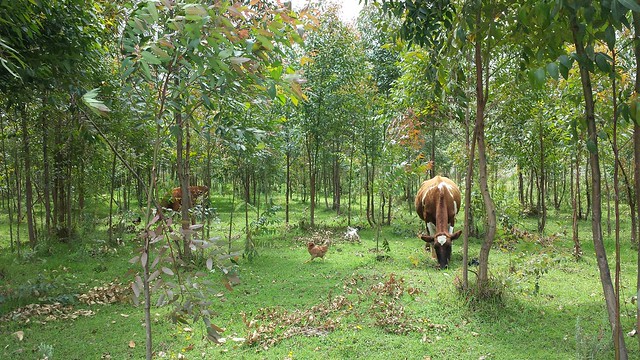
20150611_124650

New journal article: "Advancing Conservation by Understanding and Influencing Human Behavior"

Interested in what works when it comes to getting people to change their behavior and start acting in support of conservation? This paper (which I'm a minor author on) outlines different approaches to behavior change, and includes some relevant questions to determine which approach will be most successful:
http://onlinelibrary.wiley.com/doi/10.1111/conl.12252/epdf

Here's the citation:
Reddy, Sheila MW, Jensen Montambault, Yuta J. Masuda, Ayelet Gneezy, Elizabeth Keenan, William Butler, Jonathan RB Fisher, and Stanley T. Asah. "Advancing Conservation by Understanding and Influencing Human Behavior." Conservation Letters (2016).